The existing literary residencies in Croatia

The existing literary residencies in Croatia open to domestic and international writers are:


Writers' House in Pazin (http://kucazapisce.hr/en/)

The Writer's House is a cultural institution based in the town of Pazin in Istria. The formation of the House has put the organisational foundation allowing future development of new models and modalities of literary life in Istria and Croatia. This is an essential step forward in the development of the infrastructure of the Croatian literary space, and furthermore, it represents the opening of this space to international cooperation and dialogue.


Kamov Residency – City of Rijeka (https://www.kamov-residency.org/en/home)

With the Kamov Residency Programme the City of Rijeka, which has been chosen for the European Capital of Culture 2020, wishes to enable contemporary European and world creators to better understand artistic, cultural and social situation in Croatia - especially in Rijeka. At the same time, citizens of Rijeka have access to European and world artistic scene.


Kurs residency in Split (http://www.kurs.hr/hrv/pages/index#about)

With its residential programme “Marko Marulic” and the promotional activities of the international writers and translators in Split, the Association KURS connects and enables contemporary European writers and translators to familiarise themselves with the cultural and social conditions in Croatia - more specifically in Split, while at the same time the local audience benefits from the encounter with the selected European scene.


P.E.N. Croatia residency in Zagreb (http://www.pen.hr/Eng-StojePEN.asp)

Croatian P.E.N. Centre has recently started a program of a literary residence taking place in the very heart of Zagreb’s historical centre.


Ulysses’ Shelter (http.//tovar.hr)

Ulysses’ Shelter is a project co-funded by the Creative Europe Programme of the European Union aiming to build a network of exchange literary residencies across Europe and designed primarily for young writers of prose and/or poetry and literary translators. It is led by the Croatian publisher and literary agency Sandorf and managed jointly by Literature Across Frontiers in Wales, Krokodil in Belgrade, Serbia, Thraka in Larissa, Greece, and the Slovene Writers Association in Ljubljana, Slovenia.


Residency of the Croatian Literary Translators’ Association  (https://www.rezidencija.dhkp.hr)

Residency of the Croatian Literary Translators’ Association for literary translators and writers in Zagreb promotes and encourages cooperation with language institutes, language departments at the Faculty of Humanities and Social Sciences in Zagreb, publishers, festivals and international networks for residential exchange. Part of the stay of our residents is dedicated to their work on the text which brought them to Zagreb, while the other part includes activities such as panel discussions with fellow translators and writers, workshops and masterclasses at the Faculty of Humanities and Social Sciences as well as tandems with peers and guest appearances at literature festivals.


Literary residency Ante Kovačić in Marija Gorica (in making)


Croatian Soundscript brings literature into the streets of South America

The interactive mobile application Croatian Soundscript (Hrvatski zvukopis), an original project by the arts organization YELO, has arrived in Santiago, Punta Arenas, and Buenos Aires, inviting users to discover Croatian literature woven into the fabric of the city. In public spaces across these cities, users can now listen to and read 90 geolocated audio stories by Croatian contemporary and classic writers, available in Croatian, English, and Spanish.

The project was introduced in South America by Jelena Remetin, the project’s author and artistic director, alongside Jelena Miholjević, who lends her voice to selected texts, and Andrea Remetin, the producer. Presentations held at universities in Chile and Argentina were met with strong interest from students and the academic community, opening a dialogue between languages, cultures, and literary traditions.

Croatian Soundscript brings together literature, sound, and place. Stories unfold through mobile phones at specific urban locations, turning the city into an open book and inviting listeners to slow down, listen, and inhabit space through words. The project features both contemporary and classic works of Croatian literature, offering an intimate and personal encounter with language while expanding the international presence of Croatian culture.

Following earlier activations in New York, London, Paris, and Madrid, as well as in numerous Croatian cities, Croatian Soundscript now extends its listening map to South America – allowing new audiences to experience Croatian stories as living voices embedded in the world around them.


Neue Zürcher Zeitung

Ivica Djikić lets the questions of truth and morality fly around ‘en passant’, the way danger and bullets do.


Predrag Matvejević on Mirko Kovač

Kovač never let himself be assorted inside of any ideological or national frame, he’s one of the rare authors that belong to the culture of several nations, whose linguistic finesse he masterfully embedded in his writing.


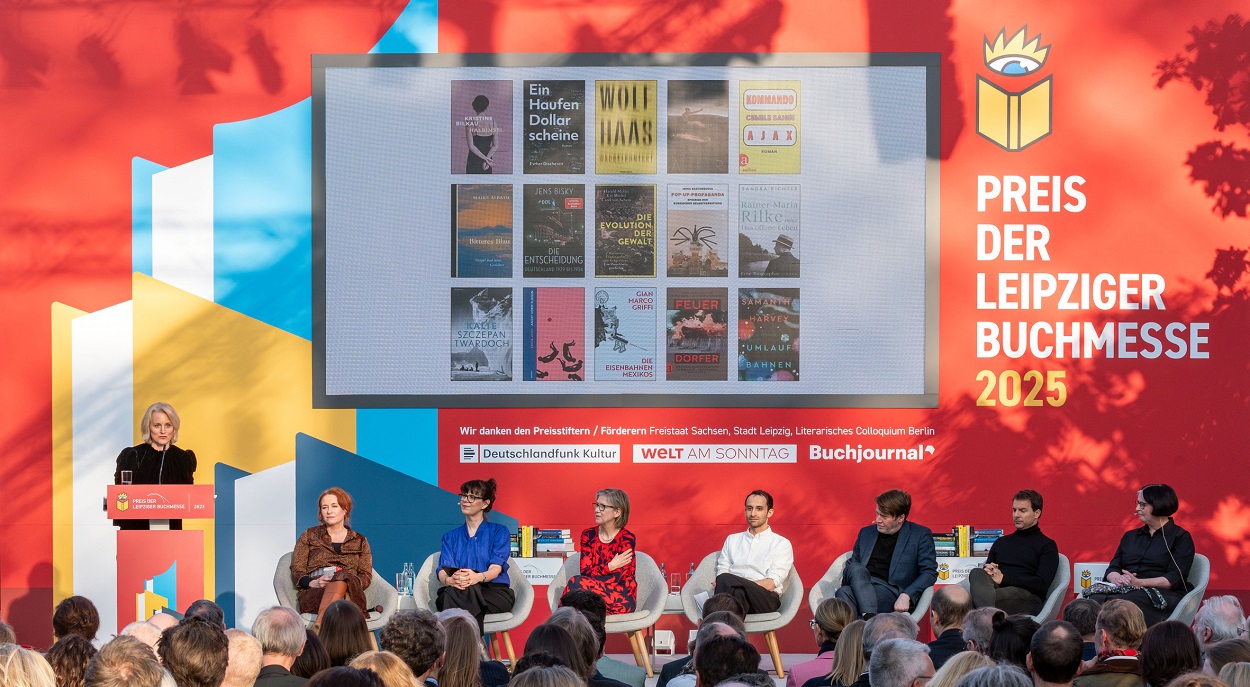
Croatian Literature at the 2026 Leipzig Book Fair

Croatian literature will be featured at the 2026 Leipzig Book Fair, one of Europe’s most important spring literary events and one of Germany’s leading book fairs, taking place from 19 to 22 March 2026. Several Croatian authors will participate in a rich and diverse program organized by the Ministry of Culture and Media in cooperation with the literary network Traduki and the Goethe-Institut.

The Leipzig Book Fair is a favorite meeting place for readers, known for the special attention it gives to authors, literary works, and literary programming, with more than two thousand events held each year. In addition, the fair continues to attract a growing number of visitors, both at the fairgrounds and across the city through the many literary events presented as part of the Leipzig liest (Leipzig Reads) program.

Although there is no official Guest of Honour country this year, the central theme of the fair is the Danube, described as a river of “strong currents that connects worlds,” which is why a number of Croatian authors have been included in the program.
 

At a panel on translating literature into German, Jasen Boko and Želimir Periš will appear alongside Marie Alpermann, a translator who has translated several works by Croatian authors into German. Slobodan Šnajder will present the German edition of his book Anđeo nestajanja (The Angel of Disappearance), published by the distinguished Austrian publishing house Zsolnay Verlag, through a series of events, panel discussions, conversations, and television interviews.

Marko Gregur will present the German translation of his novel Vošicki (Vošicki), published by Wieser Verlag, while Marina Vujčić will speak with German readers about the important themes of her novel Sigurna kuća (Safe House), published in German by Residenz Verlag.

Ena Katarina Haler will present the German edition of her novel Nevini (The Innocents), published by Folio Verlag, and will also appear in the renowned television program dedicated to literature, Das Blaue Sofa (The Blue Sofa), as part of the fair’s program.

Kristian Novak will take part in a panel devoted to dialect literature and will also present his work at Balkan Nacht – Literatur & Musik / Balkan Night – Literature & Music, held at Union-Theater Connewitz, the oldest surviving cinema in Germany, along with the Croatian musician Sara Renar.

As part of the fair’s programme, on 18 March 2026 Miljenko Jergović will receive the Leipzig Book Fair Prize for European Understanding for the German edition of his book Trojica za Kartal (Three Men for Kartal), published by Suhrkamp.

In this context, it is also worth highlighting that Lora Tomaš has been shortlisted for the European Union Prize for Literature (EUPL) with her novel Papir tvoje kože (The Paper of Your Skin). Tomaš is also this year’s recipient of the Fric Award for the best work of fiction for the same novel.


Literaturkritik.de

Djikić carefully builds a novel about the remnants of the past hiding behind the facade of today’s Croatia.


Marina Vujčić

Marina Vujčić (Trogir, 1966) holds a degree in Croatian language and literature from the Faculty of Humanities and Social Sciences in Zagreb. She worked as a Croatian language teacher for many years, before she became a Croatian literature editor at HENA COM. So far she has published six novels (Someone Else’s Life, 2010; And Then Božo Started Afresh, 2014; It Could Have Been Me, 2015; The Neighbour, 2015; A Discharge Letter, 2016 – co-authored with Ivica Ivanišević; and The Question of Anatomy, 2017), and a collection of plays Die Soft, 2014.

A successful playwright, she won the Marin Držić Award for Die Soft (2014) and Submarine (2017) while The Neighbour won the V.B.Z. & Tisak Media award for the best unpublished manuscript in 2015. Her novel And Then Božo Started Afresh, a lucid psychological novel about a man who decides to take his life into his hands and leave Dalmatia for Zagreb, was shortlisted for European Union Prize for Literature in 2014.


Mario Kolar on Salt Dark

Besides its innovative narrative structure, the novel captivates readers through its use of extensive material - much of it documentary in nature - thereby offering an original testimony of island microcosms...


Main works/Translations
Sample translation
Links
Contacts