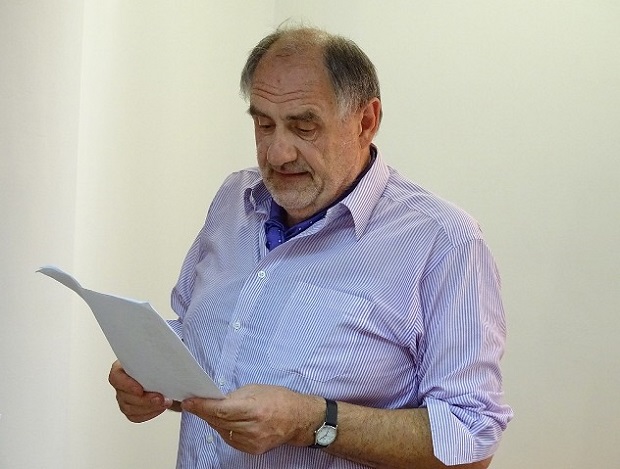
Ludwig Bauer-kontakti

FOREIGN RIGHTS


Fraktura d.o.o

T: +385 1 335 78 63
F: +385 1 335 83 20

E: fraktura@fraktura.hr


Nikola Petković

Nikola Petković (Rijeka, 1962) is an author, critic and university professor. He graduated in Comparative Literature and Philosophy from the Faculty of Humanities and Social Sciences and he continued his formation in the USA, where he worked on several universities. Since 2003, he has been a professor of Philosophy and Cultural Studies at the University of Rijeka, and Comparative Literature at the University of Zagreb.

His literary beginnings were linked to the journal Quorum. He debuted on the Croatian literary scene with the poetry collection Fairies and Elves (1984), followed by Melodies of Istra and Kvarner (1989). In 1989 he publishes his first novel Tales from Long Ago, followed by Lullaby for the Dead (2997) and How to Tie Your Shoes (2011). His novel A Journey to Gonars has been awarded with the prestigious tportal Prize for the Novel of the Year in 2019.


Miroslav Kirin-works/transl

From Her to Eternity (Od nje do vječnosti, Goranovo proljeće, 1989), poetry collection
Tantalon (Tantalon, Meandar, 1998), poetry collection
The Album (Album, Vuković & Runjić, 2001), novel, autobiographical prose
Zukva (Zukva, Vuković & Runjić, 2004), poetry collection
After the Renaissance (Iza renesanse, Matica hrvatska, 2004), poetry collection
Jalozi (Jalozi, Vuković & Runjić, 2006), poetry collection
Zbiljka, (Zbiljka, Vuković & Runjić, 2009), poetry collection
Unearthed, photographs and short essays on photography (Iskopano, fotografije i kratki eseji o fotografiji, Vuković & Runjić, 2012), essays
Puns (Zenzancije, Vuković & Runjić, 2013), poetry collection
Hipernovalis (Hipernovalis Vuković & Runjić, 2015), poetry collection
Lirka (Lirka, Vuković & Runjić, 2018), poetry collection
Little Ones (Malešne Fraktura, 2019), prose, microfiction
Babanija (Babanija, Naklada Ljevak, 2021), prose, microfiction


TRANSLATIONS*

*none so far


Ivan Lovrenović

Ivan Lovrenović (Zagreb, 1943) is a writer, journalist and editor. He graduated in South Slavic Studies and Ethnology at the Faculty of Humanities and Social Sciences in Zagreb. He worked as an editor in publishing houses Veselin Masleša, Svjetlost and Durieux. In autumn 1992, he was one of the founders of the Bosnian branch of the PEN Centre during the occupation of Sarajevo. His articles on the war in Bosnia were published in various renowned magazines, such as The NY Times, Frankfurter Rundschau, Frankfurter Algemeine Zeitung, Die Zeit, Le Messager Europeen etc.

Lovrenović is the author of numerous works of fiction and non-fiction. For his novel Gone with the Century (2014) he was awarded with the prominent Meša Selimović award for the Best Novel in Bosnia and Herzegovina, Montenegro, Serbia and Croatia. His work was translated in German, English, Hungarian and Czech. He wrote screenplays for documentaries A Hundred Years of the Natural History Museum in Sarajevo and Centuries of the Silver Bosnia


Miloš Đurđević, Poetry International

Miroslav Kirin’s poetry is suffused with deep feelings that stretch apparently endlessly and, in its nuances, conveys a number of distinct and yet somehow connected states of mind. These connections are presented through the same lyrical narrator in his poems, but it is often hard to pinpoint where a sensation starts and where it ends. The trigger that moves the entire content of a poem most probably lies somewhere outside, secluded in a physical sense from the lyrical narrator, and hence the poet has a rather limited influence on the aftermath of that initial moment of the poem.


Ludwig Bauer-sample translation

Ludwig Bauer
Homeland, Oblivion
Novel

School
The wind was flogging Mum’s blue umbrella, transforming it into a swaying glass on a wooden leg, and though I learnt to turn it towards the wind so it would regain its original shape, it still couldn’t protect me from the rain because the drops lunged at an angle, from different sides, and the wind suddenly changed its course so that the umbrella would overturn again, just when I thought that at least my head and my shoulders were protected; my legs were soaking wet and I was thinking about how good it was that I was wearing short trousers, although I was a bit cold, because the legs of long trousers would not dry - I remembered such scene from the celebration of the May 1st, when I got wet on my way to the Culture Centre and then had to sit on the folding seat which creaked while I was rubbing my palms against my ice-cold knees in order to warm them up - now the rain had nothing to soak into on my legs, it just slid down my legs, down my white socks, which were no longer white, but muddy, and then into the shoes, for some reason more rain poured into my right shoe, and the water was splashing more and more as I was hurrying, almost running towards the school – I felt the skin on my toes becoming puffed up and rough as when I bathe too long, or search for shells in the sand by the river bank. Dad had told Mum to take me to school, but she said that mothers carried their babies in their bellies, and later on kids went where they had to go by themselves, and if the stupid kid couldn’t get to school on his own, then he wasn’t mature enough to attend it; Dad nodded, he said, Well, it’s no big deal, Lukan, you can do it, and the teachers will all call out their pupils and when you hear Pavlović Lukijan, you just say, It’s me, say it loud and clear and the teacher will lead you to your classroom together with other children - actually, you have a female teacher, Ana Komljenović, comrade Ana, our woman, good cadre, a partisan – if there are any difficulties, just ask for me, I’m there from seven in the morning, I have to have a meeting with them first, but you shouldn’t ask for me if it isn’t really necessary, because it’s not very nice, I mean – people would not regard it well if you as my son needed some special help – that is why I have told you not to call me Dad, or Mile there, but comrade director, because business is business, school is school and all children have to be equal there, and I consider them equal and make no differences, but you, Mila, you could still take the boy to school, it won’t hurt your dignity, and it will leave a good impression, I mean, primarily about you, because the kid is, as you say, perfectly capable to go there by himself, aren’t you, Lukan? I think that Mum reconsidered going with me after all, because of that impression, but she glanced out the window several times and she said, Bloody rain, and she combed my hair, brushed me and tidied me up - Stand still, you shithead, you have to look fine or otherwise it will be my fault. The rain kept falling and nobody was gathering in front of the school, as Dad had said, but they were all arriving running, boys and girls, mostly under the umbrellas, but some of them had raincoats as well, some were running in pairs, mothers and children under the same umbrella, they would run through the passage between the school and the Fire station, and the janitor at the door would point at the courtyard and repeat, To the gym, everybody to the gym. Somebody pushed me from behind and I got into the crowded gym, I didn’t know anybody, everybody was bigger than me, everybody was wet, but they all knew each others and they talked, and I just looked around and then I noticed Nikola, he was also from Švabenbajer, his mum was holding his hand, but he was looking around as well, and when I approached him, he first smiled and said Hello, then he looked at me oddly, and his mother looked at me oddly and she said, You’re soaking wet, Lukan, but what has happened to your face, what is it with your face? - and then I realized that something was wrong, I remembered how Mum had grabbed my chin that morning and drawn something on my forehead, with a sort of pencil – There, you’ll look at least a bit better, she said – but I didn’t pay any notice to that because I was a bit afraid I would get lost if there was a big crowd in front of the school, actually I was not really afraid I would get lost, but that comrade Ana will forget to call my name and I would never find out which class I belonged to. But now I was standing next to a tall latticed window; I understood it was latticed so it wouldn’t get broken by a ball, because the balls were displayed on the shelf, the real balls like at a football game, not like our rag balls which were made of socks; I was standing there, the water was dripping from my umbrella, Nikola and his mum pulled away from me, as if they wanted to take a better look or as if they were afraid I was very muddy and could soil them too, Nikola was watching me with a worried expression, and his mum was nodding her head, as if somebody had asked her something and she didn’t agree with what she had been asked, some other people were watching me too, the murmur around me quietened down, more people were watching me, and I heard, Look at him, look at him, look at him... so I bent my head down as much as I could, I was watching my soaked shoes and my blue umbrella which was dripping, I placed my hand on my forehead, but I knew I couldn’t fool anybody, although my head really started to ache as soon as I touched my forehead, and then I decided, I elbowed my way to the door and ran home: I didn’t open the umbrella, I was soaked but I kept it pressed against my chest because I knew Mum would have been angry had I come home with soiled umbrella, or even worse, without it. The rain had already stopped when my Mum dragged me back to school, I was losing my balance, the road was muddy and slippery, more slippery than an hour earlier, but she firmly held my hand and I didn’t fall down, I didn’t fall down until we reached the school and saw the children leave, first grades had already been let home, so Mum stopped and then I fell down, only to my knees, and I quickly lifted myself up, and Mum said, What are we going to do now? See what you’ve done - but she didn’t say it angrily, I knew she wouldn’t hit me, she said it with concern and I thought she was afraid of Dad, and it seemed to me I understood the meaning of the word Director. Dad first looked out the window, then he approached the door, but not the door through which we had entered his office, he opened the door and I heard the hubbub of voices, but not children’s voices, they were adult voices, probably teachers’. Comrade Ana! – Dad exclaimed and she immediately came, a sturdy, erect woman, she stood still like a soldier, with her heels together, nodded her head in greeting to me and my mum, and I said Heellooo, the way Dad had taught me, but it came out squeaky and too quiet, the teacher may have not heard it at all, and Dad said we had a little problem, the teacher nodded again, and then Mum said that other children had been mocking me and I had run home, but there I was, and she pulled me by the arm, as if she wanted to hand me to the teacher, the way Tito’s baton was handed, I had seen it with my Dad in front of the Culture Centre, and the teacher was still standing erect and still like a soldier – Dad repeated, So, there was a small misunderstanding... - but the teacher said, I understand, comrade director, no problem, I already know it all; she sounded rather strict, as if she were the director instead of my Dad, although she was standing frozen in front of him. Comrade Mila, she addressed my Mum in an even stricter voice, I see you have scrubbed his forehead with a brush or something. That’s not the way to do it. You have to buy him the reading-book for the first grade and two notebooks, comrade director knows it, perhaps you have them already, one with lines, and the other for arithmetics, then a schoolbag, a pencil box, a pencil, a sharpener, an eraser. Have him bring that to school tomorrow. Kid, you are in the first A grade, on the right from the entrance. And forget they were mocking you, they will forget it too. And you, comrade, if you have Nivea or some other hautflege cream at home, apply it to his forehead - though I don’t get why you had to draw his eyebrows in the first place - as she was saying that, she turned to Dad and it seemed that question was addressed to him, not to my Mum, but it was Mum who answered: You see yourself how light and silky, almost white his eyebrows are, I just drew a little line to make them a bit darker, I didn’t want to disgrace us with a child who looks like a little Boche.


The Truth…
Mila was lying on her back, her left leg, in a plaster cast, was lifted above the hospital bed, and her arm was lifted up, held by the ropes, the cut on her forehead was stitched up and it probably added to the angry expression on her face, but she was also genuinely angry - Shitty position, as if I were saying Heil Hitler, lucky it’s not the right arm! - she wouldn’t talk to Dad, she just said through clenched teeth, Buzz off , and Dad shrugged his shoulders, arranged the glass bottles of juice on the bedside cabinet and said waveringly, I’m leaving then, maybe he was expecting Mila to stop him, but she repeated her Buzz off, so Dad motioned to me to remain and left without saying goodbye, and Mila cursed after him, she told me it was all his fault, he had destroyed her completely - At thirty-five, a woman is as horny as can be, my pussy is all aglow even here, but I can’t move, look what he’s done to me, he’s made me disabled, I’ll be walking like a dead chicken when I leave this place, I can’t stand the sight of him and I can’t listen to him, he is always sweetening everything with his words, saying sweeter and sweeter things all the time, you can’t even make him get mad at you, he is always calm as an angel from heavens, but he’s worse than the devil from the pits of hell, fuck him and his calmness and goodness which always turn things from bad to worse... - Don’t, Mila, don’t talk like that, calm down, do not get upset now, everything will be fine, you just have to be patient for this to heal, I was saying softly, glancing at the neighbouring bed in which an old woman was quietly crying for help, moaning monotonously, maybe in sleep, with her head bandaged, her arms fastened to the bed by belts, while Mila was cursing her bad luck in a rather loud voice, she took no heed of the old woman, she seemed to have forgotten about me as well, and she was staring at the ceiling and murmuring curses, but suddenly she tilted her head towards me and said, Ask him how he killed your father!
Manda probably understood that Dad and I were silent at the table because we had to say to each other something that she shouldn’t hear, Dad always insisted Manda should eat with us – She is no servant, she is a comrade who is taking care of our household! – she suddenly rose to her feet, took her plate with a piece of potato pie left and said she had work to do in the kitchen, and she’d collect our plates later. It’s all my fault, Dad said, she was actually lucky, you should have seen the car, it’s completely wrecked, I don’t understand how she managed to pass under the ramp, she was lucky it was a switcher, the small engine, and it was very slow, Mila was lucky in many things, had the ramp not rebounded, she could have gotten killed on the spot, they say that God keeps an eye on the drunkards, but the truth is that the sober need not to be protected, that’s exactly what we argued about, you know what she’s like, it wasn’t the first time, the usual thing – I take one, she takes ten, I try mildly to warn her, she spouts fi re like a dragon, everything is my fault, the drinking too, and the fact she has no school and no vocation, and I am the one who is guilty that she was raped by Chetniks when she was a child, for heaven’s sake, I hardly knew she existed then, but to her everything is my fault, the fact that I’m so much older than her and the fact that we haven’t returned to that backwoods of ours, where sheep bleat and nightingales sing, I don’t know what she’s put into her head, I’m guilty for being too patient, for not banging my fists against the table, I’m too meek and apparently I lie to everybody and deceive everybody, like a priest, essentially she is sick and tired of all of it and I admit, I lost my patience, and I think I cursed, not her directly, you know that I don’t curse and I try not to off end anybody, but this time I cursed, but not her, I repeat, nor did I curse to her, but generally, you curse the life when you think you’re at the end of your tether, and I did tell her that she was responsible for all her calamities, that she was killing both me and herself by that drinking of hers, and that I saved her ass from shit so many times, yes, I admit, I said it in those very words, you know then how upset I was, I said I had enough, I said she got completely out of hand, long time ago, so if she wanted to destroy herself, she could go ahead, be my guest, I won’t move a finger, and when she took the keys and dashed out, I remained sitting, I admit, I didn’t budge, I was just sitting here and holding my head in my hands, and I could catch up with her on the stairs and make her stop, even by force...
Mila says you killed my father...
Father? Am I not good enough any more?
You’ve always been good enough, but we both know you’re not my real... my biological father.
We know, you say... there you are... Yes, I thought we were going to talk about it at another time... a more convenient moment... I didn’t kill your father, but I did kill and I carry it as a heavy burden on my conscience, I’d almost say on my soul, but I don’t like the religious meaning of the word, not only because as a materialist I believe that with death we cease to exist as beings, but also because as I get older, I tend to believe that death erases all human mistakes, actually the idea that the man goes to another word with all the burden he managed to cram on his poor being, or his conscience, such idea is truly horrifying... so, I didn’t kill your father, though it could have happened because war is a very confusing thing, and very basic, something like the greatest storm you can imagine, a sudden bad weather which catches you somewhere outside shelter, and forces you to look for a shelter under the most unfavourable conditions, you are wet, flogged by the wind, the rain obstructs your view and hurts your eyes, and you are near the trees which attract thunder, well, war is like that, except that in war thunders are bullets and grenades you need to avoid, and you can oppose them only if you shoot as well, shoot blindly, the best you can in such a storm, so I shot in the war as much as was necessary and as much as I could, I saw our enemies killed, I saw dismembered bodies lying where we used to throw bombs, but I never really saw I had killed anyone, like you see it in the movies, when the main character shoots at someone and the other guy falls down, not until that young man, Franz Baumann, he may have been a relative of yours on your mother’s side, or of your friend Maksi, at least I think so judging by his family name, or at least I thought so at the time. You know, the National Liberation Committee gave me the house, immediately after the Boches were chasen away, and I wanted to settle down as soon as possible, for Mila’s sake, she was just a child then, a child with both childhood and youth destroyed, and I wanted to protect her, to give her a possibility to recover from everything she had suffered, and a part of it I’d suffered with her, so we moved in and everything was fi ne, we had enough things, some we got through the Committee, but a lot was from the previous tenants, I didn’t know it at first so I explored bit by bit every day, a corner here, a corner there, the basement, the attic, I checked if I could find anything useful or anything to be thrown away, because there was a lot to be thrown away, and so I was searching the shed one afternoon and I heard something under the roof, the comrades were there nearby so I called them, one couldn’t have been too cautious then, those were such times, there was a sort of an attic in that shed, I mean boards placed across traverses, some hay or straw, few boxes, crates, I don’t know what, one way or another a lot of dust, so I was not particularly eager to clear it away, and then I heard that noise up there, the boards cracking, creaking, I still had the reflexes of a warrior, I was wearing the uniform, the belt and everything, with the pistol in the holster, of course I was, because it was not really over yet, they kept mentioning some crusaders, there were ambushes and murders, comrades got killed long after the war, for your information, anyway, I unbuttoned the holster and slowly made my way up the ladder, there was a commotion again, one of us shouted Hands up, but fiercely, because when a man senses the danger, when he has a gun in his hand, when he smells the gunpowder, everything is somehow sharper, more dangerous, threatening, Hands up, I echoed and other comrades joined me, two of them were inside with me, two more were outside, and we shouted again, Hands up or I’ll shoot, I aimed into the air and a tile shattered like when you drop a glass onto the stone floor, and then a man appeared, with his hands up, but I saw him squeezing something in one hand and I was sure it was a bomb, and I could already see him throwing it down at as, I had nowhere to run, being there half way up the ladder, and naturally, the fear, the reflexes, the war reflexes as I have already mentioned, and I was getting ready to shoot when a burst echoed behind my back, my comrade had a machine-gun, and the man in the attic fell down on the planks, he was dead right away, probably even before he touched the planks, and he dropped what he’d been holding in his hand, and I saw - it was a potato, bloody hell, he’d been holding a potato in his hand, and then I heard the other one shouting Don’t shoot, I surrender, but he wouldn’t show himself out of fear, so we made him climb down and tell us everything, his name was Karl, Schuster or Schneider, I’m not sure, I don’t remember, but one of those professions was his family name, anyway, we tied him up, naturally, he was a prisoner after all, though he was actually just a boy, and Karl told us how a whole group of young boys had been recruited by force, here at Švabenbajer, into that bloody Prinz Eugen Divison, and they dragged around here, and anyway the two of them managed to escape somehow, and he explained that the other guy, who unfortunately got killed, was called Franz Baumann and that he was his friend and his neighbour, it just fell to us to kill someone when the war was already over, and that someone was a boy, a boy who had suffered a lot and hoped to find rescue in his homeland, what an illusion, homeland, now you have it, now you don’t, I’ve lost my homeland, but that’s another story, anyway, they ran away from the SS, they deserted, they threw away those uniforms, managed to get some civilian clothes and hid everywhere, because the danger threatened both from Germans and from the National Liberation Army, that is from Partizanen, as they say, they managed to join a group of liberated camp inmates who were returning home, they reached their village, they had no idea what had happened here, but they hoped that here, in their homeland, they would find somebody they knew and some shelter, in one word, they hoped to find the salvation, the illusion, as I’ve already told you, eh, the homeland, and so we handed him to the comrades responsible for such matters and I asked them to deport the guy as soon as possible, because what else could have been done, so they took him to the deportation camp... and that gave rise to that story... hm... what can I say, it is simply a gossip, that I killed your father too... I mean, he is dead, the war killed him, but I’m not a criminal, I was liberating my country, I had ideals, I risked my life for them, I was not fighting because I wanted, because I liked it, and I can honestly tell you: I didn’t like it at all. I can’t tell you anything about your father, try to see it as I’ve told you, the war took him and that’s the end of the story, but I was blamed for it... no reason... I won’t talk about it... conscience, you know, my conscience bothered me because of that boy, although he was a Boche, although the war habits were still fresh and everything that had happened was still fresh, the blood which had spilled over the planks in the attic of the shed, it couldn’t be washed away, I had to burn the planks and turn over the soil on the floor, that blood made me feel I owed something to the people whose house I had moved in, I was not a savage, although I had come from the woods, I was a country teacher, an educational worker, a man who inspires a better attitude towards life, I think you understand what I mean, and I looked for the previous owners, or better to say I tried to find out what had happened to them, there, it was because of that young man as well, although he was an enemy, you can’t deny it, that’s what Mila meant when she said that, she meant that young man, your father was no longer alive then... and so I decided... it was not simple, but I pulled some strings, I was still in uniform, a war political officer, it was still appreciated, and I found out that the old ones had died, and of the young ones, your father... he was gone... he could have disappeared somewhere in Russia or Poland, the front moved then, and your mother was in a camp with the baby, waiting for the deportation when the opportunity presented itself, and since I was already deep into the inquiry, I went on, I got in touch with her, the camp commander was full of understanding, he thought I was looking for something that those Boches had hidden in the house, or dug in the garden, anyway, he connected me with your mother who was practically dying, you’ve never seen such sick people, and you’re lucky not to have seen them, because it’s a horrible sight, and I managed to explain, with the help of a priest who happened to be there, I explained I wanted to help somehow, if I could, any way I could, but she was already delirious, the poor woman had completely lost her mind, so an old woman tried to bring her to with a damp cloth, she wiped her forehead, and your mother was murmuring something, the priest was with her, he understood what she was saying ‘cause he was nodding his head, and I was about to leave, but the priest came after me and told me about you, the dying woman is begging mercy for her little son, she is begging me not to allow that her son dies in the camp, to adopt him if I can and never let him know he is a German, it took me a week to arrange everything, to make it all proper and almost legal, actually there were no real laws then, but I wanted it to be official and in writing, so that nobody could ever deny you are my son...

From Germany to Germany
This is a camp, I told Georg, you enter it as you enter a camp, through the concrete blocks and barbed wire, and while you are entering, you’re being watched by the barrel of a machine-gun, Georg laughed, he opened the door of his car, adjusted my suitcase which had slid forward during the drive and said, All right then, you passed it, there is no wire here, see how big this square is, everything is open and free, and the wire between us and the occupied, West Berlin, does not necessarily mean that we are in a camp, maybe it’s them who are in the camp. He parked under the crown of a linden-tree, in front of a line of the grey three-storey buildings, the tree was very old, it must have been there before those grey ugly buildings, and it seemed lonely on the edge of the cracked tarmac next to a ribbon of earth lined with stone blocks, which was probably supposed to be a lawn, but the soil was dry and nothing grew there, not even the weed. Trudi brought a blue china bowl with a silver ladle and placed it on the table. Inheritance, she said, I’ve inherited that from my aunt, they are both pre-war, Meissen porcelain is only for export these days, I hope you like the soup, the soup was made from potatoes, potato soup with sour cream and the sausage that was, according to Trudi, from Poland, and Georg poured the red Bulgarian wine into ancient glasses, probably also inherited, and proposed a toast, Let this not be a camp for you, but freedom, and Trudi said that some of the local people felt somewhat like in a camp, after all this is officially a separate territory, the Soviet zone, even if it is Hauptstadt der Deutsche Demokratische Republik, Yes, yes, Georg said, polls do indicate that our citizens are more satisfied with their lives here than those on the other side, in the West, eighty percent of our citizens are completely satisfied, almost all men, and the malcontent are mostly women, but eighty percent is a high percentage, the meaning of socialism is social justice, justice for the majority, you know, our institute has done some research and I can tell you that the biggest fault that our respondents have found with the life in GDR is waiting too long for the car you have paid, especially for a wartburg, you don’t wait so long for a trabant, well, when you put it in the context of real life problems and relations in today’s world, then that objection is at the same time one of the greatest compliments to the achievements of our society, and you will find out that the possibilities for scientific research here are better than anywhere else, with a number of privileges that the state gives to the scientists.
Georg was probably alluding to the kitchenette apartment on the third floor of a big and long grey building, trimmed with sandcoloured balconies, when he drove me to the building, those balconies seemed to sparkle in the semi-darkness like metal buttons on the dark uniforms of the lined up gigantic soldiers, the apartment was assigned to me even before my arrival, together with the position of a senior research fellow at the Institute for Social Research in which Georg held an undefined executive office, they called it Analytics Coordinator, but that office was probably high enough for Georg to promise I could carry on the research on migrations of Germans in the nineteenth and twentieth century, he even gave me an assistant, Britt Berghoff, they called her BB, like the actress, Brigitte Bardot, but I can tell you that our BB is even more beautiful, a tall blonde, a really Swedish type, I think you will be tempted and therefore I’m warning you in advance, love affairs are not welcomed at work, we have certain party guidelines in that regard, still – people are people, you know how it goes, most of the young ones end up married to someone from their closest working environment, and that is perfectly fi ne, such marriages are regarded as something desirable, I do understand that it is a paradox, as if marriage comes all of a sudden, like, nothing, nothing, and then suddenly the marriage, well yes, you can’t help it, no society is free of paradoxes, I hope you like it here, the kitchen is rather spacious, though I don’t know how oft en you will use it, the Institute provide meals, lunch and snack, decent food and very very cheap, still it’s not bad to have your own kitchenette, is it, you can take off this Lenin’s picture if you want, I wouldn’t want you to think it’s obligatory, far from that, it was left by your predecessor, a comrade from Spain, he seeked asylum here and now he could finally go back, he couldn’t do it immediately after the dictator died, but luckily things do change a bit, you’ve heard that phrase Americans have coined: “Generalissimo Francisco Franco is still dead!”

Translation by Mirna Čubranić


Dražen Katunarić

Dražen Katunarić (Zagreb, 1954), author, editor and translator. Graduated in Philosophy from the University of Strasbourg, Katunarić published his first poetry collection, Bacchus in Marble in 1983. Since then, he wrote over 20 poetry and prosaistic work, such as Imposture (1987), High Seas (1988), A Song of Stjepan (1995), Decadence House (1992), Diocletian’s Palace (2006), One Day There Was Night: Selected and New Poems (2015). 

For his collection Nightingale Trap he received the prestigious Matica Hrvatska Award, one of many international accolades Katunarić was awarded with for his work. He also won the Tin Ujević award, the European Circle award, the Naji Naaman Award, Steiermaerkische Sparkasse Award and the French Order of Arts and Letters. His poetry has been translated in over 10 languages.


Pero Kvesić

Pero Kvesić (Zagreb, 1950), a writer, journalist and editor. He’s a founder of the magazines Polet and Quorum. During hi long and prolific career, he wrote over 20 short stories collections, novels, children’s books and autobiographical writings. He’s best known for his collections An Introduction to Pero K., Memories of an Editor of the Erotica Magazine, Time of War and Leisure, Writer of Undecent Stories, and for the novels What They Do To Me, What I Do to Them, Rent-a- Car Express, A Chain of Events

Kvesić is the author of the popular children’s series The Flying Teddy Bears, under the mentorship of the Oscar-winning Dušan Vukotić. He wrote screenplays for several documentaries, TV dramas, short films and series. His movie debut, Dum spiro spero, won the Gran Prix Award at the Days of the Croatian Cinema in 2016.


Main works/Translations
Sample translation
Links
Contacts