Daša Drndić: TRIESTE (Sonnenschein; excerpt from a novel)

TRIESTE (Sonnenschein; excerpt from a novel)

For sixty-two years she has been waiting.
She sits and rocks by a tall window in a room on the third floor of an Austro-Hungarian building in the old part of Old Gorizia. The rocking chair is old and, as she rocks, it whimpers.
Is that the chair whimpering or is it me? she asks the deep emptiness, which, like every emptiness, spreads its putrid cloak in all directions to draw her in, her, the woman rocking, to swallow her, blanket her, swamp her, envelop her, ready her for the rubbish heap where the emptiness, her emptiness, is piling the corpses, already stiffened, of the past. She sits in front of her old-fashioned darkened window, her breathing shallow, halting (as if she were sobbing, but she isn’t) and at first she tries to get rid of the stench of stale air around her, waving her hand as if shooing away flies, then to her face, as if splashing it or brushing cobwebs from her lashes. Foul breath (whose? whose?) fills the room, rising to a raging torrent and she knows she must arrange the pebbles around her gravestone, now, just in case, in case he doesn’t come, in case he does, after she has been expecting him for sixty-two years.

He will come.
I will come.

She hears voices where there are none. Her voices are dead. All the same, she converses with the voices of the dead, she quibbles with them, sometimes she slumps limply into their arms and they whisper to her and guide her through landscapes she has forgotten. There are times when events boil over in her mind and then her thoughts become an avenue of statues, granite, marble, stone statues, plaster figures that do nothing but move their lips and tremble. This must be borne. Without the voices she is alone, trapped in her own skull that grows softer and more vulnerable by the day, like the skull of a newborn, in which her brain, already somewhat mummified, pulses wearily in the murky liquid, slowly, like her heart; after all, everything is diminishing. Her eyes are small and fill readily with tears. She summons non-existent voices, the voices that have left her, summons them to replenish her abandonment.
By her feet there is a big red basket, reaching to her knees. From the basket she takes out her life and hangs it on the imaginary clothes line of reality. She takes out letters, some of them more than a hundred years old, photographs, postcards, newspaper clippings, magazines, and leafs through them, she thumbs through the pile of lifeless paper and then sorts it yet again, this time on the floor, or on the desk by the window. She arranges her existence. She is the embodiment of her ancestors, her kin, her faith, the cities and towns where she has lived, her time, fat sweeping time like one of those gigantic cakes which master chefs of the little towns of Mitteleuropa bake for popular festivities on squares, and then she takes it and she swallows it and hoards it, walls herself in, and all of that now rots and decomposes inside her.
She is wildly calm. She listens to a sermon for dirty ears and drapes herself in the histories of others, here in the spacious room in the old building at Via Aprica 47, in Gorica, known as Gorizia in Italian, Gorz in German, and Gurize in the Friulian dialect, in a miniature cosmos at the foot of the Alps, where the River Isonzo, or Soča, joins the River Vipava, at the borders of fallen empires.
Her story is a small one, one of innumerable stories about encounters, about the traces preserved of human contact. She knows this, just as she knows that Earth can slumber until all these stories of the world are arranged in a vast cosmic patchwork which will wrap around it. And until then history, reality’s phantom, will continue to unravel, chop, take to pieces, snatch patches of the universe and sew them into its own death shroud. She knows that without her story the job will be incomplete, just as she knows that there is no end, that the end reaches on to eternity, beyond existence. She knows that the end is madness, as Umberto Saba once told her while he was in hospital here, in Gorizia, in Dr Basaglia’s ward perhaps, or maybe it was in Trieste with Dr Weiss. She knows that the end is a dream from which there is no waking. And the shortcuts she takes, the quickest ways to get from one place to the next, are often nearly impassable, truly goats’ paths. These shortcuts may stir her nostalgia for those long, straight, rectilinear, provincial roads, also something Umberto Saba told her then, so she sweeps away the underbrush of her memory now, memories for which she cannot say whether they even sank to the threshold of memory, or are still in the present, set aside, stored, tucked away. It is along these overgrown shortcuts that she walks. She knows there is no such thing as coincidence; there is no such thing as the famous brick which falls on a person’s head; there are links – and resolve – of which we seem to be unaware, for which we search.
She sits and rocks, her silence is unbearable.
It is Monday, 3 July, 2006.

HURRY UP PLEASE IT ’S TIME

Her name is Haya Tedeschi. She was born on 9 February, 1923, in Gorizia. Her documents state that she was baptized on 8 April of that same year, in 1923, by Father Aldo Boschin who, of course, she does not remember, just as she has no memory of her godmother, Margherita Collenz. There is also a baptism celebrated by Don Carlo Baubela. Baubela is a German name. She meets Don Carlo Baubela in the autumn of 1944 when he is already old and hunched over and, spreading the fragrance of incense and tobacco with his half-frozen, trembling hands, he gives his blessing. Gorizia is a charming little town. There have been interesting histories in Gorizia, little family histories, like this one of hers. She never met many of the members of her family. She has never even heard of quite a few of them. Her mother’s and her father’s families are large. There are, there were, families in Gorizia with tangled stories, but their stories do not matter, despite the way history has been trailing them along with it for centuries, just as rapids sweep along broken branches wrenched free of the shore, and the carcasses of livestock, their bellies bloated, cows, their eyes glassy, tailless rats, corpses with their throats slit, and suicides. There were no suicides in her family. Or if there were, no-one ever spoke of them to her.
There were several well-known people who lived in Gorizia and committed suicide. Many people passed through Gorizia on the run. Some stayed, some were taken away. Of these some were Jews, some were Gentiles. Of these, some were poets, philosophers and painters. Women and men. The most famous person to commit suicide in Gorizia was Carlo Michelstaedter.
Her mother’s name was Ada Baar . . .
It took her years to assemble the information from which she tailored her mangled family tree and learned who was what to whom. For a long time now she has had no-one to ask. Those who remain are few, and their memories are blotted, full of gaps, covered with the black stamps of oblivion or contention and like little islands engulfed in towering flames – they shimmer, elusive. The dead voices of her ancestors shudder, whimper, well up from the corners of the room, from the floor, the ceiling, they creep in through the Venetian blinds and hum history just beyond her reach.
She has no idea what her ancestors looked like. There is no proof. Nothing remains.

Her family rattle on the bottom of the trough (of her memory). Today the limbs, her family’s branches, are so jumbled, so dislocated, it is impossible to settle on their whereabouts. The organs of her family are strewn all over. The lives of her ancestors matter less and less for her story, however, for her wait.
Her grandfather was born in Görz. Her mother was born in Görz. She was born in Gorizia/Gorica. When the Great War broke out, they began moving, living in many places. She doesn’t know what Görz was, nor does she know what Gorizia is now though she has been here nearly sixty years. She takes walks along Gorizia’s streets, but hers are brief forays, quick walks, walks with a purpose, jaunts. Even when she takes longer strolls, when her strolls are more leisurely (when the days are mild and her room feels stale, a humid inertia), Haya doesn’t notice the big changes in her surroundings. She feels as if she has been sitting for sixty years in a shrinking room, a room whose walls are moving slowly inward to meet at a miniature surface, a line, at the apex of which she sits, crushed. She cannot see, nor is she watching. She has wax plugs in her ears. She does not hear. Görz, Gorizia, are memories. She isn’t certain whose memories they are. Hers or her family’s. Maybe they are fresh memories. When she goes out she squints at the sun, picks daisies, sits at the Joy Café and smokes. She has not let herself go. She does not wear black. She is not forever rocking back and forth. All is as it should be. She has a television. She has little memories, darting memories, fragmented. She sways on the threads of the past. On the threads of history. She swings on a spider’s web. She is very light. Around her, in her, now is quiet. Gorizia has a history, she has a history. The days are so old.
Sometimes she dreams
she is dragging her mother in a plastic sack. she is dragging her by the legs. she wants to hide her. one of her mother’s legs snaps off. Her mother is dead, but she says, hide that leg, bury it near the stationery shop at the intersection of seminario and ascoli; take the rest to rose valley, that is what she says
Her grandfather, grandmother and mother are born as subjects of the Habsburg Monarchy to which their ancestors came long before, from Spain, she thinks. She is born in Italy. They speak
German, Italian and Slovenian, mostly Italian. Grandmother Marisa was a Slovene, as was her great-grandmother, Marija. Both died young. Her family did not mix much with others in terms of race and nationality, yet they became mixed. Today all her ancestors are jumbled, impossible to disentangle.
An oft-thumbed family booklet, a guidebook of sorts from 1780 that Haya Tedeschi keeps on the desk by the window with a dozen old volumes and several pamphlets, says that Görz or Goritz is an ancient city on the banks of the River Lizono, situated in Gorizia, in a small province by the name of Friuli, a possession of the House of Austria. Sovereignty over the Gorizia Habsburgs is lost between 1508 and 1509 when the Venetians rule the town, building it into a fortification, only to lose it during the Napoleonic Wars, when it becomes part of the Illyrian provinces. The castle (1780) still dominates Gorizia. In the second half of the eighteenth century, the guidebook says, a synagogue was built there, suggesting the influx of a colourful community. Gorizia lies about thirty kilometres to the north of Aquileia and, according to the guidebook, some seventy kilometres north of Venice. The town of Gorizia is in a wooded area,
not far from a road that ran, in Roman times, from Aquileia to Emona. The name of the town appears first in a document dated 28 April, 1001 (“quae sclavonica lingua vocatur Goritia”), with which Emperor Otto III makes a gift of the fort and settlement to Patriarch Giovanni II and Verihen Eppenstein, the Count of Friuli. Today, the guidebook says, Gorizia is an archbishopric with jurisdiction over the bishoprics of Trieste, Trento, Como and Pedena.
Her grandfather Bruno Baar fights in the Austrian Army during World War One. His half-brother Roberto Golombek, a student in Vienna at the time, opens a dentistry office there at Weinberggasse 16 in 1924. Roberto moves to Great Britain in 1939 and gets a job at a sardine factory, so that between 1943 and 1945 the Baar family, while still living at Via Favetti 13 in Gorizia, is supplied, who knows how, with vast quantities of salted sardines, thanks to which they survive the bleakest years of World War Two.
As of May 1915, Italy is no longer neutral. It has not been granted Trentino, the Southern Tyrol and Istria by Austria-Hungary, which it had demanded in return for staying on the sidelines. Rarely does war leave anyone on the sidelines. Hence, affronted, Italy conducts secret talks with the Triple Entente, after which it crosses over and joins them. Invariably there are conflicting sides in any war. The Great War was a conflict between two sides led by the selfsame purpose. To conquer the world. For themselves. For one side. When it enters the war on the side of the Triple Entente, Italy asks again for: Trentino, Trieste, the Slovenian coastline, Istria, a part of Dalmatia and Albania, as well as the right to the Turkish provinces of Adalia and Smyrna, expansion of the colonies in Africa, and so forth. Italy asks for a great deal. What is not granted after World War One, Italy strives to make up for in the next war. Wars are games on a grand scale. Self-indulgent young men move little lead soldiers around on manycoloured maps. They draw in the gains. Then they go to bed. The maps hover in the sky like paper aeroplanes, then settle over cities, fields, mountains and rivers. They cover people, figurines, which the great strategians then shift elsewhere, move here, there, along with their houses and their stupid dreams. The maps of the unbridled military leaders cover what was there, bury the past. When the game is done, the warriors rest. Then historians step up to fashion falsehoods out of the heartless games of those who are never satiated. A new past is written which the new military leaders then draw on to new maps so the game will never end. Italy joins the Triple Entente. A new front is created – the Italian front. Major battles are fought along the Soča. The Soča flows through Gorica, Gorizia, Görz, Goritz. The Soča, the Isonzo, is a river of a vivid turquoise hue. In its river bed it holds a history which eludes historians. The Soča is a river much like a person. Quiet one moment, raging the next. When it rages, it is mighty. When it is quiet, it sings. The Italians wage four terrible battles in 1915 along the Soča. In the Sixth Battle of the Soča (there are eleven or twelve all told), in 1916, the Italians finally capture Gorizia. They shout Viva! Evviva Italia! The Soča is red. Blinded. The rains tell it, we will heal your wounds. The rains push fiercely into the Soča, like lovers gone wild. The Soča is silent. The muddy and bloodstained waters rise, but the rains do not rinse them clean. On the river bottom roll bones which, like a huge baby’s rattle, disturb its dreams. To this day.

Translated from the Croatian by Ellen Elias-Bursać


Neven Ušumović-sample translation

NEVEN UŠUMOVIĆ
Chikungunya

Of course he didn’t take him all the way to the Croatian border. He left him near Parecag, at a bus station. This driver, without saying a word, drove all the way to Koper in silence; all right, true, it was Monday, no one felt like talking. He only said srečno, wished him good luck, and motioned him to get out. He crossed the road and after only a few steps found the place where he could continue hitchhiking.
He noticed a pile of worn car tires only after the first sting. The sun was not yet burning properly so the tires did not give that stifling smell he loved so much. The drops of last night’s rain glistened on them. He approached them with anger. He knew it well, by the sting, tiger mosquitoes, they nested here and formed their little clouds of pleasure.
Relentless mosquitoes were part of everyday life around here. Ever since the 1980s, they’d been coming her together with imported goods from Asia, and now these little tigers were biting non-stop, regardless of the time of day and without much buzzing. The only thing was that these years there’d been more of them, too many.
The sun shined on the exact spot where he was standing. After a couple of minutes it became unbearable and he had to turn his back to the road. In front of him there was a patch of feeble clover and then reeds through which a path for joggers and hikers passed, where bicycles were ridden through. Behind that were soline, muddy fields of salt, their swampy stench slowly rising as the day grew older. For a while he couldn’t take his eyes of a bicycle whose frame blazed unbearably under the sunrays. For a moment it seemed to him that the frame had freed itself from its wheels and floated in the air like a giant letter.
He turned towards the road and soon a car with Pula license plates stopped. This driver was very chatty, but unfortunately he went only as far as Buje. He didn’t want to tell him what was business in Oprtalj; still, he gave him the basics about his illness and tiger mosquitoes.
Refik lived his life of a retiree in one of the blocks at Markovec, above Koper. He had a terrace, which he used as a dump yard for bicycle tires. Patching, fixing tires was his passion for the days in retirement, he did it for his own pleasure. To kill time, he charged people just for the sake of it, because the Slovenians loved that. The problem was the rain season: he’d dry, arrange and rearrange all of them, but in some tires, in that tangle, the water remained for months, and the mosquitoes thanked him wholeheartedly by laying their eggs, breeding relentlessly. Still, even after everything that had happened to him, Refik did not lose his sense of humor: “So the word of my generosity,” he said to his curious driver, “spread among the mosquitoes and one day one of them treated me to some nasty virus. For two days I lay in Izola Hospital with a fever, a headache, I couldn’t even glance at the sun, and the worst of all, and I feel it to this day, and it will stay with me until I die, my joints had swollen and it hurt as if a dog bit me and wanted to tear off my leg. Ni zdravila za čikungunju, that’s what he told me, the doctor, there’s no cure for Chikunguyna. Hang in there, Refik, don’t give up… That’s how I won over the disease.”
Buje were already in sight, up high; it seemed this had somehow quieted Refik down. The driver’s eyes kept falling on his jittery hands, hands of a craftsman: a web of black lines over his fingers. Those fingers could not calm down, they were breaking from emptiness, straining with nothing to do.
As a mason, Refik also worked in this part of the country, especially in and around Grožnjan. Now he was supposed to go towards Oprtalj, luckily not all the way, but a bit closer, to Makovci. In any case, he no longer felt like hitchhiking: he took the road over Triban.
The sun shined on each step he made, he climbed uncaringly, not noticing things around him. Again he engaged in his deaf-and-dumb discussion with the Slovenian nurses in Izola; they showed no respect for the old Refik. At least not as much as he expected. He gloated that now, at this very moment, he was doing exactly what got him in quarrel with them in the first place; izogibajte se gibanju na prostem, that’s what he caught on to, he didn’t even listen to what else they had to say: he not to move, but that’s like they gave him to sign his own death sentence! It might be that they got angry with him too because to their question, Kje vas je pičil komar, he answered with approval: “Bah, pinched me, yes – hell, yes, it pinched me like a motherfucker!”
He stopped for a second in the shadow of a rundown stone house, however, the swallows were so loud that his thoughts got completely tangled. Eh, if I pinch you…
Finally, he turned around to look where he was, clear shadows of trees danced on the edge of the road ahead of him. First grains of sweat appeared on his temples, he wiped them away with his palm. This reminded him that he was on the way to get urine.
The urine of a woman he’d never seen before, only talked to her on the phone. His neighbor Maja – when, over a cup of coffee, he told her how he suffered and read his half-wrinkled diagnosis to her, because that he didn’t know by heart, that Chikungunya, which sounded like an insult to him – gave him the number. She could barely wait, don’t you listen to them doctors, that was her favorite sentence, she always had all kinds of honey and tea, and now she came into her own; she knew of a woman who had such urine that not only healed your skin, but no mosquito would even smell you – and you don’t smell – she added immediately. But this was precisely what interested Refik the most, how come you don’t smell, she pees on you, yet you don’t smell, how do you get that? First, she doesn’t pee on you, you get the bottle, you pay for it, and then you rub it in yourself, second, this urine is left to rest for a couple of days, it’s not like if you peed right now! – she snapped right back at him.
But, even now, when he was already on his way to Makovci, Refik could not get the image out of his mind: he’s lying, some young woman above him – she’s peeing, urinating on him. That’s what pulled him on, until he freed himself of that image, until he got the urine, he would not be able to calm down, he realized one night. Nevertheless, it took him a few days, until he made a decision. Wherever he saw a woman, an attractive one, he imagined himself under her legs, soaked in urine, that image was stronger than him, he simply had to go see her. “Eh, damn you”, he said to Maja, who stuck some money and a list of medicines she’d ordered from that same woman, Blanka, into his hands.
I’d already forgotten all about women, Refik thought in anguish, as Triban grew smaller behind his back. And now this urine! The more he imagined the scene, the wilder Blanka became, she took different positions and tortured him.
He closed his eyes, as if this will chase the images out of his mind, and picked up his pace. When he glanced at the road in front of him again, he realized there were only trees around him, no man in sight, no house. That always troubled him. He picked up his pace even more to set himself free from that inner fatigue – bah, he can’t go back now, not after all these kilometers he’s crossed!
Church towers had already sounded the noon, hunger started to bore around his stomach. He didn’t like to eat. When there was light, he would spend time on his terrace among the tires, perhaps he would light a cigarette, but now not even that. He even avoided drinking water! He was only worried that he wouldn’t be able to find Blanka’s house, he’d hardly seen anyone along the way, and he’d have to ask around, people just had to know of her, if not by her pee, then by her herbs and tees.
He was all sticky with sweat and dust. His strength was giving up on him. He made his way through some bushes, entered a little among the trees and found a clearing where he could lie down. Oak branches above him coiled like hungry snakes. An absolute quiet all around him. He smiled. To travel over such a distance by the end of your days because of a woman! And what for?! To have her pee on you.
(…)


Dražen Katunarić-works/transl

MAIN WORKS

Bacchus in Marble (Mramorni Bakho, Mladost, 1983), poetry
The Sandtrap (Pjeskolovka, Zbirka Biškupić, 1985), poetry
Imposture (Himba, Zbirka Biškupić, 1987), poetry
High Sea (Pučina, Naprijed, 1988), poetry
Psalms (Psalmi, Zbirka Biškupić, 1990), poetry
The Steep Voice (Strmi glas, Grafički zavod Hrvatske, 1991), poetry
House of Decadence (Kuća dekadencije, Naklada MD, 2002), essays
Sky/Earth (Nebo/Zemlja, Durieux, 1993), poetry
Church, Street, Zoo, (Crkva, ulica, zoološki vrt, Hrvatska sveučilišna naklada, 1994), essays
A Song of Stjepan (Pjesan o Stjepanu, Perun, 1995), poetry
Barbarogenius’ Return (Povratak Barbarogenija, Belus, 1995), essays
The Nightingale Trap (Lijepak za slavuja¸Matica Hrvatska, 1998)
Story of a Cave (Priča o špilji¸ Matica Hrvatska, 1998), short stories
Well-read Heart (Načitano srce, Ceres, 1999), poetry
Parabola (Parabola, Jutro poezije, 2001), poetry
Fatal Images (Kobne slike, Konzor, 2002), short stories
Tiger Balm and Other Stories (Tigrova mast i druge priče, Litteris, 2005), short stories
Diocletian’s Palace (Dioklecijanova palača, Hrvatski PEN centar, 2006), essays
Delirium (Lira/Delirij, Litteris, 2006), poetry
Internet and Other Writings (Internet i drugi tekstovi, Litteris, 2010), essays
Kronos (Kronos, Litteris, 2011), poetry
One Day There Was Night (Jednog dana bila je noć, Litteris, 2015), poetry
A Sign in the Shadows (Znak u sjeni, Litteris, 2015)
Padre Pio’s Smile (Smiješak Padra Pija, Hena com, 2017), novel


TRANSLATIONS

Ecclesia Invisibilis (Selected poems): Romanian (Orient-Occident)
Isolomania: Albanian (Ajaccio)
Cherries: English (Blue Aster Press)
Barbarogenius’ Return: Macedonian (Ditet e Naimit)
Sky/Earth: French (L’Arbre a paroles), Romanian (Cronedit)
Tiger Balm and Other stories: French (M.E.O)
The Beggar Woman: German (Leykam)
House of Decadence: French (Monde- Édition- Ouverture)
Cronos: Spanish (Editorial Krivodol Press)


Nora Verde

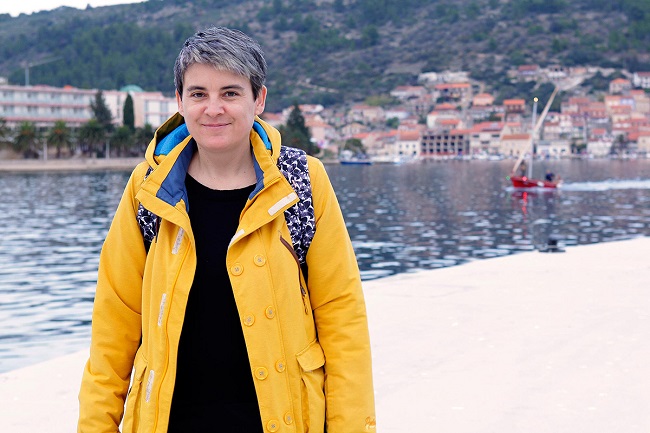
Nora Verde (Antonela Marušić; Dubrovnik, 1974) works as a journalist and editor of daily and weekly newspapers and non-profit media in the areas of culture, music, television, civil society, human rights and independent media. She graduated in Croatian language and literature and published her first book as a student, a poetry collection The Season of Getaways (1994). Since 2010, she publishes her books under a pen name Nora Verde. Hew oeuvre includes prose books Lend Me a Smile (2010), While Stocks Last (2013, novel), On Love, Beatings and Revolution (2016), and My Dowry (2021 novel) – which was shortlisted for tportal Award for the best novel, and longlisted for Fric Award for best prose fiction.

Verde’s prose and poetry have been translated into English, German, Slovene, Albanian and Macedonian, and published in numerous magazines and collections, including: Vijenac, Homo Volans, Zadarska smotra, Zadarski list. Her stories were published in the collections A Decent Life – Lesbian Short Stories from Ex-Yugoslavia (Pristojan život – lezbejske kratke priče s prostora Ex Yu, 2012), Pepper, Short Stories On Reconciliation (Biber, kratke priče na temu pomirenja, 2016) and a book Zagreb Noir (Akashic Books, New York, 2016).

She is a member of the editorial board of the Croatian feminist portal Vox Feminae, the Croatian Writers Society and the Croatian Freelance Artists’ Association.


Foto: (c) Dino Cetinić


NevenU-works/transl

MAIN WORKS

Seven Youths (7 mladih, naklada MD, 1997), short stories
Excursion (Ekskurzija, Naklada MD, 2001), novel
Poppy Seed (Makovo zrno, Profil International, 2009)
Birds of Heaven (Rajske ptice, Profil knjiga, 2012)
The Golden Burn (Zlatna opeklina, Sandorf, 2019), essays


TRANSLATIONS

Vereš: USA (Dalkey Archive Press), Italy (Terzo Millenio)


Pero Kvesić-works/transl

MAIN WORKS

An Introduction to Pero K. (Uvod u Peru K,, CDD, 1975), short stories
Revenge (Osveta, ICR, 1983), short stories
Young K. (Mladi K., Znanje, 1983), short stories
What They Do to Me, What I Do to Them (Što mi rade, što im radim, Nezavisna uzdanja, 1984), novel
The Flying Teddy Bears (Mladi leteći medvjedići, Mladinska knjiga, 1990), children’s illustrated book
Happiness of a Sad Dragon (Sreća tužnog zmaja, Meandar, 2000), children’s illustrated book
Rent-a-car Express (Rent-a-car Express, Areagrafika, 2000), novel
Cassandra’s Fears (Kasandrine slutnje, Staiergraf, 2000), short stories
Chain of Events (Stjecaj okolnosti, Meandar, 2002), novel
Memories of an Editor of the Erotica Magazine (Uspomene urednika erotskog magazina, Zoro, 2003), short stories
The Nightingaler (Slavujevac, Astroida, 2004), poetry
Time of War and Leisure (Vrijeme rata i razonode, Durieux, 2010), short stories
Poodles Fly South (Pudli lete na jug, HENA, 2014), short stories
Writer of Undecent Stories (Pisac prostih priča, HENA, 2015), short stories
Best Birdhouse in the World (Najbolja ptičja kuća na svijetu, Društvo prvih pisaca, 2015), children’s book
Dum Spiro Spero (Dum spiro spero, Factum, 2017), autobiography
Corkscrew Man Meets the Fish Woman (Čovjek-vadičep sreće ženu-ribu, Fraktura, 2018), short stories
 

TRANSLATIONS*

*none so far


Nora Verde-works/transl

MAIN WORKS


The Season of Getaways (Sezona bjegova, Narodno sveičilište, 1994), poetry collection
Lend Me a Smile (Posudi mi smajl, Meandar, 2010), prose / novel
While Stocks Last (Do isteka zaliha, Sandorf, 2013), novel
On Love, Beatings and Revolution (O ljubavi, batinama i revoluciji, Sandorf, 2016), prose / stories
My Dowry (Moja dota, Naklada OceanMOre, 2021), novel
Beatings: A Picture Book for Grown-Ups (Batine : slikovnica za odrasle, Knjiga u centru, 2022), A Picture Book for Grown-Ups


TRANSLATIONS*

While Stocks Last: Slovenian (Založba Litera)


Slavenka Drakulić-works/transl

MAIN WORKS

Deadly Sins of Feminism (Smrtni grijesi feminizma, Znanje, 1984), non-fiction
Holograms of Fear (Hologrami straha, Grafički zavod Hrvatske, 1988), novel
Marble Skin (Mramorna koža, Grafički zavod Hrvatske, 1989), novel
How we survived communism and even laughed (Kako smo preživjeli, Vintage, 1991), essays
The Balkan Express (Balkan-express, W.W. Norton & Company, 1992), essays
The Taste of a Man (Božanska glad, Durieux, 1995), novel
Café Europa (Café Europa, Penguin Books, 1996), essays
How did we survive (Kako smo preživjeli, Feral Tribune, 1997), essays
S.: A Novel about the Balkans (Kao da me nema, Feral Tribune, 1999), novel
They Wouldn't Hurt a Fly (Oni ne bi ni mrava zgazili, Kultura & Rasvjeta, 2003), essays
Flesh of her Flesh (Tijelo njenog tijela, Europapress Holding, 2006), essays
Frida's Bed (Frida ili o boli, Profil International, 2007), novel
Two Underdogs and a Cat (2009), essays
A Guided Tour through the Museum of Communism (Basne o komunizmu, Profil multimedia, 2009), essays
Accused (Optužena, V.B.Z., 2012), novel
Dora and the Minotaur. My Life with Picasso (Dora i Minotaur. Moj život s Picassom, Fraktura, 2015), novel
Mileva Einstein: A Theory of Sadness (Mileva Einstein: teorija tuge, Fraktura, 2016), novel
Invisible Woman and Other Stories (Nevidljiva žena i druge priče, Fraktura, 2018), short stories
Café Europa Revisited: How to Survive Post-Communism (Ponovo u kavani Europa: Kako preživjeti postsocijalizam, Fraktura, 2021), essays
My Place Under the Sun (Moje mjesto pod suncem, Bodoni, 2021)
Deadly Sins of Feminism, Extended Edition (Smrtni grijesi feminizma, prošireno izdanje, Fraktura, 2020), essays
Café Europa Revisited: How to Survive Post-Communism (Ponovo u kavani Europa: Kako preživjeti postsocijalizam, Fraktura, 2021), essays
My Place Under the Sun (Moje mjesto pod suncem, Bodoni, 2021)
War is the Same Everywhere (Rat je svugdje isti, Fraktura, 2022), essays
What We Don’t Talk About (O čemu ne govorimo, Fraktura, 2024) short stories collection


TRANSLATIONS

Accused: Slovakia (Aspekt), Slovenia (VBZ)
A Guided Tour through the Museum of Communism: USA (Penguin), Sweden (Natur och kultur), Slovakia (Aspekt), Bulgaria (Žanet 45), Italy (B.C.Dalai editore), Serbia (Rende), Albania (ISHM)
Frida's Bed: Austria/Germany (Zolnay), Sweden (Natur och kultur), USA (Penguin), Slovenia (VBZ), Serbia (Profil Belgrade), Italy (La Tartaruga), Hungary (Libri Kiado), Macedonia (Ikona)
Flesh of her Flesh: Serbia (B92), Sweden (Norstedts), Austria/Germany (Zsolnay), Poland (WAB), Macedonia (Skenpoint)
They Wouldn't Hurt a Fly: Netherlands (De Geus), UK (Abacus –TimeWarner), USA (Viking), Serbia (B92), Sweden (Norstedts), Austria/Germany (Zsolnay), Denmark (Lindhardt ok Ringhof), Norway (Humanist), Hungary (Jelenkor), Finland (Like OY), Poland (WAB), Spain (Global Rhythm Press), Portugal (Pedra da Lua), Romania (Curtea Veche)
S.: A Novel about the Balkans: Sweden (Norstedts), Norway (Gyldendal), UK (Avacus), Germany (Aufbau), Finland (Otava), Italy (Rizzoli), Netherlands (De Geus), Slovenia (Aleph), Spain (Anagrama), France (Belfond les etrangeres), Portugal (Asa), India (Green Books)
Café Europa: Netherlands (de Prom), Sweden (Norstedts), USA (Penguin), Germany (Aufbau), Italy (il Saggiatore), Greece (Akti-Oxy), Japan (M.Nagaba), Taiwan (Business Weekly Publications)
The Taste of a Man: Netherlands (de Prom), Sweden (Norstedts), USA (Penguin), Germany (Aufbau), Italy (il Saggiatore), UK (Abacus), Norway (Gyldendal), Denmark (Gyldendal), Slovenia (Rotis), Spain (Anagrama), Albania (Konica), 
The Balkan Express: USA (Harper), Slovenia (Rotis), Germany (Rowohlt), UK (Hutchinson), Sweden (Ordfronts), France (Mentha), Denmark (Spektrum), Italy (il Saggiatore), Hungary (Kobra Konyvek), Norway (Aventura), Netherlands (de Prom), Finland (Kaantopiiri Oy), Japan (Sanseido), Romania (Athena)
How we survived communism and even laughed: France (Jacques Bertoin), Norway (Pax), Sweden (Ordfronts), Italy (il Saggiatore), USA (Harper), Slovenia (Rotis), Germany (Rowohlt), Netherlands (de Prom) 
Marble Skin: Spain (Grupo libro), France (Robert Laffont), Italy (Giunti), USA (Harper), Netherlands (de Prom), UK (Hutchinson), Sweden (Ordfronts), Germany (Aufbau)
Holograms of Fear: Sweden (Norstedts), USA (Norton), Netherlands (de Prom), UK (Hutchinson), Germany (Rowohlt), Slovenia (Prešernova družba)
Café Europa Revisited: Italy (Keller), Japan (Jimbun Shoin), USA (Penguin Books)


Ankica Tomić-works/transl

MAIN WORKS 

Especially during Summer (Naročito ljeti, V.B.Z., 2011), novel
Ladies Caprice (Damen kapric, Naklada Ljevak, 1014), novel
Vice Versa (Vice versa, Naklada Ljevak, 2016), novel
Scarabaei (Skarabej, HENA, 2018), novel


TRANSLATIONS*

*none so far


Publishers Weekly

Zagreb, Croatia – its culture and its touchstones – will be terra incognita for many U.S. readers... Notable is Nora Verde's She-Warrior, in which a young woman's carefully planned anarchist activities are smacked down by a triple helping of reality.


Main works/Translations
Sample translation
Links
Contacts