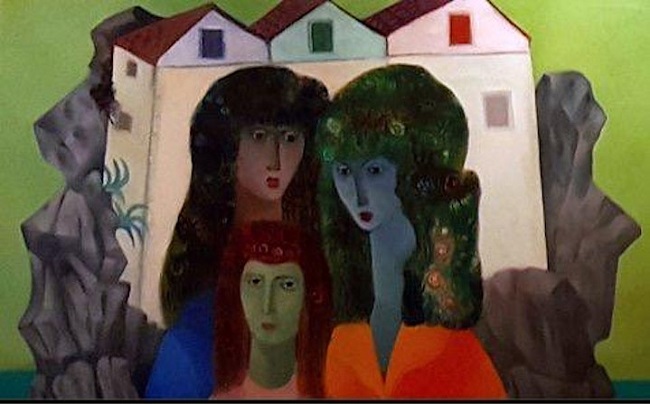
ACCUSED

ACCUSED
novel

“I made you and I can break you.”

 A hot summer afternoon. Little Girl is playing on the balcony with her doll. She notices a red convertible gliding down the street and recognizes the man at the wheel. It’s Daddy, she whispers to her doll, glancing worriedly at the balcony door, as if scared that somebody might hear her. All the same, when the car pulls over she decides to give him a timid wave through the balcony railing. A tall handsome young man steps out of the car, humming a tune, but he does not look up and takes no notice of Little Girl waving at him.
Little Girl sees Mommy come out of the building in a short white dress. She opens her mouth to call out to her, but changes her mind. Mommy has her sunglasses on and a wide-brimmed red hat on her head. She is wearing bright red lipstick, which is how Little Girl knows that she’ll be left on her own for a while, at least until Grandma comes back from her afternoon shift. Mommy looks up at the balcony and frowns. She waves her inside. Then she steps into the car, removing her hat. The breeze ruffles her dark wavy hair. Daddy puts his arm around her bare shoulders. She tosses back her head, laughing. Little Girl watches them drive off, lost in her own thoughts. She knows that she should go back to her room and lie down. Every time Mommy goes away with Daddy, she says: When you are home alone, you’ve got to go to your bed and stay put. You can play with your doll, but don’t make any noise.
Her doll is her best friend. Little Girl tells her the kind of secrets that she can’t confide to anybody else. Mommy’s secrets. She says to her doll: See? I told you this morning that Mommy would be seeing Daddy today, but Grandma mustn’t know. The doll nods her head. Little Girl knows she won’t say anything. Any other girl in the neighborhood would immediately blurt out something like that. They don’t know that grown-ups’ secrets are different from children’s and that you must never ever give them away, not even if they lock you up in a dark pantry or the cellar. Or beat you with a belt.
She cradles her doll, sings to her some more and then goes to her room.


Let’s go, the stocky policewoman said, shoving me into the official car, as if expecting me to put up a fight, or maybe even try to get away. Sick of the stale air in my cell, I had stopped on the sidewalk in front of the prison to breathe in the sweet smell of spring. I could feel my lungs happily expand and I went slightly dizzy from the rush of oxygen. The women’s wing, like the rest of the prison, probably reeks of dank and the combined smells of body odor, sweat, floor cleaning products and the guards’ cheap deodorants. Spring hasn’t yet reached us deep down in the stone belly of the old prison building, and who knows if it ever will. Will it ever be able to squeeze through those small barred windows or will we get just the remnants of spring, those shards of sunlight strewn on the gray concrete floor like fragments of gold?

The courtroom reminds me of my classroom in high school, and it’s not that much bigger either. The same white, dusty walls, the same plywood furniture, even the raised tables. All that’s missing is a big blackboard on the wall behind the judge, who looks like the school principal. Despite the flickering daylight pushing its way through the open windows, the neon lighting casts a pall over the crowded courtroom. Everybody looks ashen, as if they have got some sort of disease - from the police to the judge, from the prosecutor and my defense attorney to members of the trial chamber, the witnesses and reporters. My face probably looks the same. Maybe everybody simply feels sick at the very sight of me? I can feel their eyes sliding over me like the clammy tentacles of some blind, curious creature.
For months the press wrote extensively about my case and the dilemmas it posed. It painstakingly reported the police reconstruction of the crime, providing evocative descriptions, so that readers could devour every detail of the scene of the crime and trajectory of the bullets, and scour the photographs for signs of evil on my face over their morning coffee. But in the courtroom I try to keep the same expression on my face. They’re probably trying to figure out if it is indifference, disinterest or lack of passion. The only thing I want them to see is a blank mask. If only they new how much practice it took for me to slip it on.


I try not to let my eyes scan the courtroom for familiar faces because that might stoke my real feelings of fear and helplessness. I’m on my own at this trial, and I’ve decided not to ask for anybody’s help. I do not want my father to testify for the defense. Or my ex-husband, who when I walk in throws a worried look my way, then furrows his brow and tries to read my mood, his almost boyish-looking face suddenly looking old. I asked him not to come, to stay at home with our young daughter, but he wants to show everybody that he is standing by me.
Out of the corner of my eye I see an older woman suddenly get up from her aisle seat and leave the courtroom, head bowed. Maybe she knows me from somewhere? But why is she here then? She must have known, everybody in the courtroom knows, what I am on trial for. They have come to hear for themselves, every detail - the charges, witness testimonies and arguments. Standing between us are piles of newspaper articles, heaps of words and stacks of files, their contempt, maybe even hatred, and my own stubborn silence. Where have you all been until now? I think, as the policewoman shows me to my seat, the one reserved for the accused. So now I interest them, but where were they when I was little and needed help, Little Girl crouching in her inner prison with nobody to hear her screams.
“The Accused - A Cold-Blooded Murder or an Accidental Killing?” screamed the headline announcing today’s trial. What the public in the courtroom wants to know is how I am going to behave and will I break my stubborn silence and speak out in my own defense. But they won’t hear a word from me, not a single word! From the very start I told my court-appointed lawyer that I would not speak. So your defense is silence? she asked. No, I said, I won’t defend myself at all. But why not? she asked in surprise. The prosecutor commented, not without a hint of sympathy, that I was condemning myself in advance. I don’t think that they are all malicious in their quest for answers; I understand that they want to hear me explain my actions.
Why did I shoot? Why won’t I defend myself?
I remember vividly how the inspector, when he first questioned me, asked why I had done it. Because my little girl was crying so hard, I told him, as if it was the most normal thing in the world. I was afraid for my child, I tried to explain. He looked at me in disbelief. And that’s all? Yes, I replied, though, it wasn’t all, of course, but I couldn’t tell him that.

That day last fall, she had been lying dead on the floor for some time. Somebody kept ringing the doorbell. I was afraid that the noise would wake the child up and I had only just managed to get her to sleep, so I opened the door. Two policemen were standing in the doorway. The younger one asked me if everything was alright because the neighbors had reported gunshots. I nodded my head. I did it out of habit. I had been taught that if somebody asked me how I was I should always say: Fine, thank you. People don’t care how you are, Mom would say. When I came to school all black and blue and somebody asked if I was ok, or if a neighbor asked how I was, I always had to say I am fine. The same policeman asked me if there was anybody else in the apartment. I don’t really know why I nodded toward the living room.
Of course I was aware of what I did, though in a strange way, as if it was happening to somebody else. Maybe this event finally put some order in my life .
A different, deeper sense of order, one that the police officer would not be able to understand. But how to explain that to the man in uniform who opened the living room door, took a horrified look at the corpse, and then at me? He was pale, about to faint. I could see dark stains of sweat spreading under his arms, even though the room was cold. He took out his phone, made a call, speaking nervously – a woman…on the floor…dead, yes, yes, I checked. His voice raised, he was shaken, maybe this was the first time he had to deal with such a situation. I was standing in the hallway, afraid that all this noise would wake up my little girl asleep in the other room. She was all I was thinking about, I didn’t care about the commotion, the doors suddenly opening and closing, more people coming in, crawling all over the place, while I stood there, dispossessed.
Then they phoned my husband to come and pick up the child. They told him that I was being arrested, that I was a murder suspect. We waited for him to arrive and then the police took me to the station. As we left, the door next to mine cracked open. It was the neighbor I had been talking to a little earlier, she peered out through the dark, like a cockroach irresistibly drawn to the smell of death.

Little Girl and her mommy move into Grandma and Grandpa’s apartment and Mommy’s old room. It isn’t big; it has two narrow beds and a big closet. It holds Mommy’s old high school books and there are posters of bands glued to the inside of its doors. The Beatles, the Rolling Stones – Little Girl reads their names, proud that she already knows how. There is also a dressing table with a big mirror, which Grandma and Grandpa moved to the room when they bought themselves a new bedroom set. When she stands in front of it, Little Girl can see only half of herself. The upper half. When she was much smaller and they were living with her daddy, she was confused because she couldn’t see her legs in a similar mirror that Granny, her other grandma, had. Look Mommy, I have no feet, she would say, pointing at herself in the mirror. It made her mommy smile and Little Girl would repeat it like a parrot just to hear her ringing laugh. Her mommy still laughed a lot then, her deep throaty laughter would fill the house, every room, floating above Little Girl like a white fluffy cloud.
Mommy always takes a long time to get ready when she is going out with Daddy. Little Girl sits on the bed, watching her try on her clothes. As usual, she can’t make up her mind. What looks better, the red, knee-length dress or the white short dress with straps? she asks Little Girl. But really she is just talking to herself, to the person she sees in the mirror. I think Daddy will like this white one better, she says, quickly slipping the dress over her head and wriggling her naked body into it. Then she sits on the bed to let Little Girl zip her up. The child watches the zipper slowly slide up over the smooth, bronzed skin and inhales her warm smell, Mommy’s smell.
Little Girl likes the flowery dress best, the one her mommy sometimes wears to work or when she has to take her to the hospital for a check-up. That dress makes her look more like the other mommies in the playground and on the street. Their third floor neighbor has a dress like that. But she dresses like a peasant, she knows nothing about fashion, Mommy says.


It is stuffy in the courtroom. The air is heavy, the room is packed because the district attorney will read out the charges today.
Facing the judges from the dock, I have to hold on tight to the wooden railing, with both hands. The air from the half-open window barely reaches me and I can feel beads of sweat forming on my temples and above my lip. I try to listen carefully. There is a succession of people taking the floor in front of me. I wish I didn’t have to listen to all of this again.
The district attorney reads out the monotonous text in a flat voice. I miss some of the words; he seems to swallow them.
“As per article 41, paragraph 2, item 3 of the Law on Criminal Procedure,….,a student, married, mother of a minor, currently being held for trial…,did on…. in apartment…, fire two shots at the victim from a 9 millimeter….pistol, one from a distance of 90 centimeters and the other with the pistol pressed against the body…, internal organs…inflicting a lethal gunshot wound causing instantaneous death…the accused declared…I quote: ‘I tried to get to the child, I was to afraid for her life. My mother was aggressive.’ ”

You are mine and mine only. I made you and I can break you.

The first bullet didn’t bring Mom down, she didn’t give in. She even managed to spit out the words: You misery! She mustered the strength to hurt me even as she was dying. I shut my eyes. I stepped closer and fired again. She dropped to her knees, then leaned against the couch. When she finally fell silent I remember that the pistol in my hands suddenly felt heavy.


DinkoT-works/transl

MAIN WORKS

Clashes (Kreševa, 1997), poetry
Gardens & The Red Phase (Vrtovi & Crvena mijena, AGM, 2003), poetry
Freedom and Time (Sloboda i vrijeme, Naklada Jesenski i Turk, 2003), tractate
Beyond (Iza, AGM, 2005) poetry
Lotus, Dust and Puppy (Lotos, prah i mak, Naklada Jesenski i Turk, 2008), travel book
The Desert and other un-timely essays (Pustinja i drugi ne-vremeni ogledi, SysPrint, 2009), essays
Needlestack (Plast igala, HDP, 2011) poems
Deserter (Dezerter, Algoritam, 2013), novel
Asian Suite (Azijska suita, Sandorf, 2015), travel book
Until Your Eyes Burn Down (Dok ti oči ne dogore, Fraktura, 2017), poetry
Reasons Enough: And Other Poems (Dovoljni razlozi: I druge pjesme, Fraktura, 2021), poetry
 

TRANSLATIONS

Poets' Paradise: India (Guntur), co-author
The Fancy Realm: India (Guntur), co-author
Poetic Bliss: India (Guntur), co-author
Each Olive is a Melted Star / Cada oliva és un estel fos, 2010), bilingual Catalan – Croatian edition, co-author (Editorial Denes)


Marko Gregur-works/transl

MAIN WORKS

Lyrical Graphomania (Lirska grafomanija, Ceres, 2011), poetry collection
Peglica in December (Peglica u prosincu, DHK, 2012), short stories collection
Lovely Day for Drinkopoly (Divan dan za Drinkopoly, Algoritam, 2014), short sotires
The end of Mr Trombetassicz (Kak je zgorel presvetli Trombetassizc, Hena com, 2018), novel
Your Name Could Be Leda (Mogla bi se zvati Leda, Hena com, 2018), novel
Vošicki (Vošicki, Hena com, 2020), novel
The Shutters (Šalaporte, Hena com, 2023) novel
Exposition of Darkness (Ekspozicija, Hena com, 2024) novel


TRANSLATIONS*

*none so far


Vanja Kulaš, Kritika H.D.P.

 "My Dowry" is a book that repays debts, fights against patriarchal darkness, and, in the literary sense, deserves a good position in the corpus of contemporary Croatian literature.


The Guardian

This slim, lucidly written book is an outstanding read.


Take Six: Six Balkan Women Writers, book launch at LBF 2023

Take Six: Six Balkan Women Writers, published by Dedalus Books (United Kingdom, April 2023) and edited by Will Firth, brings together six unique female voices: Magdalena Blažević (Bosnia and Hercegovina), Tatjana Gromača (Croatia), Vesna Perić (Serbia), Natali Spasova (North Macedonia), Ana Svetel (Slovenija) and Sonja Živaljević (Crna Gora).

We invite all to join the book launch, to be held during the London Book Fair, on Wednesday, April 19th at 6:30 pm

This compilation of prose – classic short stories, travel writing, diarylike accounts and stand-alone chapters from a hard-hitting novel – has been translated by Will Firth and Olivia Hellewell. It is the newest addition to Take Six series of women's prose anthologies Dedalus Books launched in 2018, and Croatian authors Magdalena Blažević and Tatjana Gromača are featured with five texts.

Tatjana Gromača (Sisak, 1971) is an award-winning Croatian author, whose works have been translated into several languages including English, Italian, German, Polish, Slovenian. Last year she published a travel prose collection Berlin, Pula, Warsaw (Sandrof, 2022) – and parts have been included in the Take Six compilation. These literary walks, infused with the author’s recognizable ironic-philosophical style, follow her journey, and paint a picture of Croatia within its Central European and Mediterranean context.

Magdalena Blažević (Žepče, 1982.) received several awards for her short stories, which have been translated into English, Russian and Macedonian. Some are included in her collection Festival (Fraktura, 2020), and just recently she published her first novel In Late Summer (Fraktura, 2022).

The editor of this collection and its main translator, Will Firth (1965), is an Australian literary translator who lives and works in Berlin. He studied German, Russian, Croatian and Serbian at the Australian National University in Canberra, completed postgraduate studies in South Slavic studies at the University of Zagreb and Russian philology at the Pushkin Institute in Moscow. He translated the works of M. Krleža, M. Crnjanski and various Croatian, Serbian, Montenegrin, Macedonian and Bosnian authors.


Richard Marcus on Frida's Bed

Of course, any attempt to interpret someone's thought patterns is pure conjecture, but from personal experience I can only concur with the conclusions Slavenka Drakulic has drawn about Frida's state of mind.


Dinko Telećan-sample translation

The first chapter of The Deserter in English translation

Along the same way, always. Through the village to the Small Pier, then the path leading to the cemetery, and then turn towards the hill next to the house that will never be completed. It’s followed by a track bordered by drystone walls, briers and brambles, trodden red earth flecked with stones, ever narrower and increasingly overgrown.
The drystone wall becomes lower and lower. On the Island they call it mocira. Mociras long ago became little more than monuments to the pre-tourist age. White networks in the dense green underbrush, appearing and disappearing. Trembling squares within which everything is the same as outside them; they would long ago have vanished completely were it not for salty winds that relentlessly tame the vegetation.
Next come a climb, sudden turns, ever more goat droppings. The trail is interrupted at a small plateau in front of the former barracks, wrapped ever tighter by brambles and supported from behind by sturdy trees, the tallest trees on the island. Almost the only ones, except for the obligatory cypresses down there in the cemetery, a few tamarisks which, shrivelled as they are, make friends with the northeast wind, and a couple of stunted olive trees. The human hand up here hasn’t touched anything in all of twenty years, when the war began and it smashed everything it could.
A skinny black goat often climbs onto the lid of a huge cistern here, looks around, once, twice, incessantly chewing, then jumps onto a stone at its base and disappears into the thicket. This dense thicket, rough as a cat’s tongue, which I constantly feel on the skin of my forearms and lower legs.
When I go around the barracks and head along the path leading further up the hill, I usually take my first look behind. Actually, my eyes can be closed, and I may ignore what season of the year it is, to know what can be seen down there in the harbour: if the smell is thick, heavy, bitter-sweet, and chirping is equally dense and loud, against the background of a distant murmur, then hundreds of white masts are visible below, then the sea is lined with tracks of ships, boats and yachts, then the movement of people, thoughts, speeches, desires is vaguely discerned. Summer. If the smell is harsher, if silence, occasionally ripped by the screams of seagulls, leans upon one’s body, then the sea down there is darker, composed of some other, cold, liquid where only small white wooden boats that make a tuk-tuk-tuk sound dare to navigate, leaving and returning infinitely slowly. Winter.
Across the bay there is another, higher, hill. On its summit there is a small church, and, seen from afar, a regular zigzag path leads to it. I seldom go there.
I climb further, my tool box becoming doubly heavy. Two more big turns await me, a considerable slope, and here I am on the stone plateau. At the top. Between the stones under my feet, only rare particles of red soil. Low underbrush. And the wind blows always, always. When the north-easter blows it’s unpleasant, but good. All the channels are opened up. A clarity arises in all the senses. I can see far away without straining. One just needs to hold on to something: to one’s own firm steps, to the thought of a spring fruit, of returning to a heated room, of the long trawl line which waits for too long, of an Andalusian square in the summer noon, in the meridional moment when the whiteness burns everything and everything is burned to whiteness.
My two pillars are waiting for me, recently painted in red and white stripes. One of them stands on the first plateau, where I trod after the ascent. By the loose path that leads along the ridge I reach the smaller plateau, which houses the transmitter of the rival mobile operator. Two equal concrete pedestals, slightly different structures. Sometimes I like the first, the older one, more, sometimes the other, erected later. Depending on that, and it seems that it has to do with whether the bora or sirocco is blowing – less often, of course, the landward breeze, tramuntana or levanat as well – I piss on one or the other, having turned myself downwind. There is also the south-wester called libeccio, which makes me urinate in the northeast direction, and then the droplets sputter into the distance, sometimes even further than the concrete, and spray a whole barberry bush. In these circumstances, I contemplate a small island which is a copy of the Island, thus also being a butterfly or an opened shell. Only that this smaller island has been abandoned of late, and in its southern bay there is only a small ramshackle stone castle. The opposite cove is sandy, and from this summit of mine one can clearly see the sand and the bright blue sea, which almost reaches the abandoned, and yet miraculously preserved, houses and cisterns of the former village. The inhabitants left this place because the bay is too shallow, so larger ships cannot put ashore to bring the benefits of progress. Some people are still alive and now most live on the Island.
When the landward breeze blows, I turn myself to the Citie, whose lights can be seen on clear nights, just as, on the opposite side, in the days cleared up by the bora, Italy is visible. When the north-easter plays its whistling tune, I turn southwest and return to the places from which I returned here: to Andalusia, then beyond Gibraltar. I close my eyes, take a running start, I grow wings, I grow feathers, my nostrils are filled with Morocco, mint tea on the palate, the screams of dark children and the coloratura of muezzins in my ears. The Citie, however, now only means Errands – I say “I’m going on Errands”, I see it through, buy what is needed and return the same day, or the following one at the latest. The Citie means the past, which means it does not exist. Or it is there as a long-abandoned, ravelled bird's nest hung on a wall as a decoration or keepsake.
When pissing down the wind is done, I set about examining the posts, first the older and then the younger one, as is due. I check the connections and cables, lubricate as necessary, clean the salty spots. Only very seldom some more serious failure occurs, and when it does it’s mainly on the newer transmitter. Then the whole forenoon has to be spent on the repair, but at least I know that I didn’t drag all the tools up for nothing. Just as I hadn’t attended that absurd vocational school in vain. I’ve grown so close to my columns that I’ve also given them names: Vjeko is the older one, and the younger is called Tiko.
It was a windfall, this job of mine, there is no dispute about it. And I got it immediately upon the Return. It was Vjeko’s company which first invited applications. Maintenance of a transmitter, I was qualified for that, and there were no other candidates on the Island. The salary was small, but one could survive with it here. Not even a year passed before applications for a maintainer-custodian were invited by Tiko’s company as well. I was the logical choice. In addition to the qualifications, I already had almost a year of experience. Tiko’s dad even offered a little more money than Vjeko’s, so I had quite a bundle guaranteed on the monthly basis now. In Toni's store I don’t always have to choose the cheaper pasta, and I can go to the Citie when I feel like it. Even if I don’t feel like it often.
So I sold myself. Once again.
And, of course, I got a mobile phone from each of the companies. First zero phones, then two of them. A small Vjeko and a small Tiko. I fell for it, used them, and they used me; I was calling and I was responding, I babbled and chatted and twaddled, sent SMSs and MMSs, carried them with me, became upset when I didn’t have them on me. It fell apart on the day when I found myself holding one of them in my left hand and the other at my right ear, saying to the right-hand one that I was just being called by the left-hand one, so I had to put the former, the right-hand one, on hold for a moment, just to call him again in a minute. I went to the Small Bay, still with one piece of black plastic in my left hand and the other in my right hand, and tossed both of them theatrically into the sea. I was very proud of it. What great courage and liberation! You bet. Trouble arose the same afternoon, when Vjeko’s company called me in vain to check something relating to the maintenance of the transmitter. Later I imagined how the mobile phone rang on the seabed, lying amongst the algae, and how fish gathered around it, all amazed, listening with their mouths pursed and eyes goggling as the digital version of the theme from the Turkish March repeated indefinitely.
My latest years have thus been financially secure, leaving the space and time for the smoke left from all those booms and bangs in the previous couple of years to subside or disperse, speck by speck, those endlessly burning years which might present novelistic material for someone, whereas to me, now, from this distance, they look like time spent in a semiconscious state, a state that only one single face once cleared up, or so at least it seems to me. One face and perhaps one man’s words that I, only just now I know it, once listened to with half an ear. I’m encamped in a safe haven, until further notice. The basic needs are met, if by the basic you understand that which is down, not up.
Once it seemed there were much more of these bottom needs and necessities. I did not realize how little is necessary. No, I am not an ascetic. It is not my goal to reach the "free minimum that leads to the maximum freedom", the one written about by Miro or some other rapporteur from the East, I do not remember any more, although now from the outside everything about me looks bleak and dry compared to the brim-full and sparkling glass of life from which I, whenever there was an opportunity, eagerly drank and even swore oaths to. So I like to roll a good tobacco, not too flavoured, strike a match whose flame I blow away, and which I then put in a tin box with an ambiguous A carved on the lid, comparing the fumes to clouds. I like to wash down the fish I catch with a good, dense red wine. Just as I like the fasts that accompany my silences: the days when, without doing anything, I do more than the creator of a hundred worlds. With Blackcoat I can sometimes get tipsy, and then we manage to soften dogmas beautifully. Both mine and his. With Kate it can also be nice, although this is not it, as we both know. I like to remember the words and stories of the man from the city of Fez, whose name means friend and who, in fact, sent me back here, to gather what is scattered and see what I can do, what one can do, what we can do.


Main works/Translations
Sample translation
Links
Contacts