Andrijana Kos Lajtman-works/transl

MAIN WORKS


Morning Laureate (Jutarnji laureat, Čakovec, 2008), poetry collection
Lunulae (Lunule, Disput, 2012), poetry collection
Teleidoscope (Teleidoskop, HDP, 2018), poetry collection
Stairs for Stojanka K. (Stepenice za Stojanku K., V.B.Z., 2019), poetry collection
The Infectious Zone (Zarazna zona, Fraktura, 2021), poetry collection cowritten with Damir Radić
Blue and Brown Book (Plava i smeđa knjiga, Meandar, 2021), poetry collection
 

TRANSLATIONS*

*none so far


Ivana Šojat-Kuči-sample translation

Ivana Šojat-Kuči 5
Unterstadt
I.
I don’t know why on that Friday, having returned home from work
around three p.m., I started to pack hurriedly, throwing my clothes
at random into the suitcase on wheels, which had been sitting in
the dust under the window sill since my last visit to Vienna. I don’t
know why I fi nally decided to take that train from Zagreb to Osijek,
which leaves from platform one at exactly fi ve-oh-fi ve, according
to the age-long timetable. Only an hour, an hour and half
earlier, I was attending to a plumpy, doll-like baroque angel from
a parish church in Zagorje, I was glueing its fallen, thin skin which
was peeling on all sides and revealing the wooden base that irresistibly
reminded me of the dried muscles of mummies. While I was
caressing its round, plump buttocks, my Mum and Osijek didn’t
even cross my mind, not for a second. Really, I don’t know why I
fi nally did it. Just as I didn’t know why, some ten years ago, I
popped a handful of sleeping pills down my throat. I do, however,
remember the mild and calm, almost eff eminate doctor Risjak,
who was leaning into my face as if I were a small, irascible child,
and urging me repeatedly to open up to him and tell him what
was wrong. “Nothing is wrong”, I repeated, turning my head away.
I felt I had a bad breath, I didn’t want to puff into his face. I was
ashamed and I wanted to cry: “You haven’t rinsed out my stomach
properly!” But he kept leaning into my face, as if his huge nose
were deprived of the sense of smell, and he kept saying that “nothing”
can make a man leave forever and never come back. In the
end, I stared straight into his eyes and said: “I was bored.”
But I was not bored on that Friday. Instead of running to catch
the train, I could have sat at my drawing table and spent the whole
weekend scrawling, or I could have taken a book and spent three
days in horizontal position, I could have closed the windows,
turned the fan on and not listen to the world, crawling into myself
like into a thick, cardboard box.
I don’t know why I took that train. I don’t believe in paranormal,
although I used to be genuinely scared by ghosts who were
visiting my grandmother in her little room for almost a whole year
before she died. Still, I don’t think I sensed anything, I don’t think
that an unearthly voice whispered in my ear that Mum would die
while I was sitting in the train, somewhere near Koprivnica, when
ignorant passengers thought they were returning from where they
had set off .
But Mum really died on that Friday aft ernoon, while I was sitting
in a stuff y compartment of the train clattering from Zagreb to
Osijek for four hours. I was sitting in the compartment and my
bum was getting numb, with a crossword puzzle lying in my lap,
and I was fi lling in the empty fi elds with uneven letters. Because
of the train and its constant shaking. Because of the summer which,
in that 1999, decided to take spring by surprise and made my palms
sweat and the pen slip between my fi ngers. I was casting occasional,
furtive glances at an old man who was dozing on the seat opposite
mine, with his head against the dirty, yellowish curtain which was
swaying, off and on covering his face. His mouth was open and he
was drooling. He was yellow and bony, and his hair was combed
back, greasy and grizzled. I thought of Breugel and the wretched
souls scattered on his paintings. He seemed so miserable and stinking.
Th at’s why I was tucking my legs under my seat, not wanting
them to be touched by the tips of his shabby, probably never shined
shoes. Next to me, a seat away, was an old woman who constantly
contorted her mouth and ran her tongue over the dentures, producing
a clicking sound. I would occasionally look at her out of
the corner of my eye. I was dying to tell her: “Lady, please, stop it!
You’re annoying me! I’ll pluck your dentures and throw them out
of the window!” But I didn’t say a word. I just felt my lower jaw
contract and my lips set into a straight, rigid line. At one moment,
our eyes met. My God! Th e faces of old people crease with age like
waxpaper, I thought. I stared at her blue eyes. Th e old woman, who
would later introduce herself as grandma Marica, smiled at me.
And her eyes sparkled; for a moment they looked at least thirty
years younger than the rest of her stooped, wrinkled body. In a
single blink, the nonsense about the ice-cold, calculatingly-intelligent
blue eyes crossed my mind. Both my grandmother and my
mother had blue eyes, of almost the same shade, but at the same
time they diff ered as day and night. You could read everything in
Grandma’s eyes. Th e sorrow would draw grey curtains upon them,
and the anger would light bright blue bulbs. If the eyes are windows
to our soul, then Grandma’s soul, always leaning on an elbow like
a curious woman, kept vigil above its always wide open windows.
Unlike her, it seemed that Mum had no soul at all. Her eyes were
always watery, dully blue. As if that God of my Grandma exaggerated
with my mother’s eyes, made their slits a bit too wide, thus
making them pop-eyed, blank, indiff erent to everything. I briefl y
closed my eyes and in my mind’s eye, in the dark behind my closed
lids, I saw the indiff erent, slightly dull gaze of my mother, looking
at everything and everyone blankly, like somebody who is checking
from the window if he or she should take an umbrella. Who
notices the world only if the water is pouring down from the vault
of heaven.
Thinking that I wanted to strike a conversation, grandma Marica
introduced herself and started complaining about the weather
which was too hot, about the drought which was raiding her garden
in Retfala, about her grandchildren in Zagreb and her daughter
who hadn’t come back home aft er studies, but married a man
from Zagreb, from a nice family, of course.
I was getting more and more nervous, but not because of my
Mum. I didn’t know she was dying. I didn’t feel anything at seven
twenty-fi ve p.m. Anything at all. And that’s when she died. Actually,
I was annoyed by that discreet thrusting in my face, by the
pointing at the fact that I had come into the backwoods, that I was
returning to it. I was annoyed by that damned, slow, four-hourlong
bumping in the train which stank badly, which stopped at
“every white house”, as our grandmothers used to say, which
seemed to want to show me how far I was from everything.
I remembered myself at almost nineteen, getting off the train
at the main station in Zagreb, seeing in front of myself the wide
arm of Lenuci’s horse-shoe and thinking, God, everybody here
sees I’m a foreigner! I was almost ashamed that I chewed my words
like chewing-gums, that I dragged myself down the streets, as if
crawling through the sticky, plowed black soil. It passed. I forgot
that fi rst feeling, that impression that the “backwoods” was screaming
from my forehead. But then, on that train, I remembered it all
again and I got nervous. No, my Mum never entered my mind.
I was convinced that Jozefi na exaggerated in her old woman’s
illiterate letter, written in ornate handwriting. I say old woman’s
illiterate letter because it seems that with time old people forget
the punctuation marks, and their sentences, deprived of all fullstops
and commas, melt into one another, become incomprehensible,
written higgedly-piggedly, just like the old people’s thoughts.
I know I laughed at that letter of hers, at her characters of uneven
size which resembled the young, rugged potatoes, and I thought,
Good Lord, I hope I won’t become like her one day. Old people
exaggerate with courtesies, as if incessantly apologizing, because
they already see themselves in coffi ns, because they don’t want
anyone to talk ill about them one day when they are gone, when
they would live on only in the words the living utter about them.
Occasionally, when by some miracle they cross their minds. Unless
they forget them.
I was imagining the stooped frau Jozefine with her aquiline
nose, shriveled and wrinkled old woman whose father had told
her, some twenty years ago, shortly before he died, that she would
outlive us all. Th at she would bury us all. He was joking. Th ough
he could no longer laugh, because cancer was already devouring
all air from his lungs. I was picturing her struggling with the pen,
contorting her lips, frowning, trying to summon me with her
letter, trying to soft en me, to lure me home, to Mum. I was picturing
her nodding her head with satisfaction, like a plush dog on the
head rest of the back seat of a car, writing that ornate, in my opinion
excessive words: “Your dear mother is dying my dear my little
Katarinica my little Keti”. Writing that avalanche of words without
a single comma, without a single full stop. I was picturing her
knobby fi ngers trying in every possible way to grab the pen which
was resisting, slipping, trembling on the paper and writing the
funny, uneven letters. Th ough tragical, the fact that on that train
I never even thought of my Mum is funny. I was thinking about
frau Jozefi na, frau Fine Lady, as my Dad used to call her for fun.
When, aft er nine in the evening, with my bum numb, I fi nally
got off the train, the sky was already black. Th ere were no stars.
Everything above me looked like thick black plush which, illuminated
by the streetlights, glistened like the fur of a black baskerville
dog. I was fl ooded by the sickly sweet smell of early May. I felt the
scent of hyacinths and I smiled. I remembered my grandma and
her hyacinths, which looked like processions dotted along the brick
path in front of the main door to our house. I smiled involuntarily,
as if seeing a dear, kind-hearted passer-by approaching me
with a grin. And I did not recognize the city which for a moment
smiled at me with its hyacinths. Everything was somehow diffent,
slightly changed, as if slightly shift ed aside. Near the station,
there was no longer the supermarket in which football fans and
students drowned their beers before leaving for college or returning
home, and then staggered and vomited in the trains. Although
I had seen it burning on the TV, hit by multiple rocket launcher I
guess, I was still stunned by the void, by the absence of something
that used to be there. I stopped for a moment, laid my suitcase
down on the cobble pavement made from the yellow, smooth
bricks and stared at that void in the space. I think my mouth was
slightly opened, in wonder. I think I forgot to breathe for a while.
I took a pack of cigarettes from my pocket and lit one. I was
wrapped by a bluish cloud that made it impossible for me to smell
the city. I thought about my grandma, grandma Klara, who would
certainly snatch the cigarette out of my mouth, throw it away, crush
it and say: “Nice girls don’t smoke!” She would certainly blab something
about Greta, the black sheep in grandma’s fi ne family, who
started to wear trousers and smoke cigarettes in a cigarette-holder
just before the war broke out. I smiled at the grandma, who forgot
to breathe twenty years ago and dreamt away into death. I’ll paint
her one day, on the plywood, in oil, I thought. Th e painting must
be solid and reliable like grandma, who, even in her white, laced
nightgowns, always looked as if her Almighty had carved her out
of granite.
First I thought to walk down the Radićeva Street to the tram
stop and then take the tram to the Lower Town, but then it occurred
to me that Mum was in hospital, the house was empty and
I didn’t have the key. I remembered that Mum was at work when
I went to Zagreb eighteen years ago, that I angrily left the key
under the mat. I pointedly wanted to show to my mother, who was
not there to see me going away, that I had forever slammed the
door of that house, the house which remained empty. Clean, but
empty. So I headed towards Divaltova Street, towards a back,
wretched house in which Jozefi na wrote her uneven letters and
sentences without punctuation marks.
I dragged myself down the dark, never properly illuminated
street which stretched along the railroad track all the way to Klajnova
Street. I thought: nothing has changed, this street still scares
me. I thought how the war had come and gone, how everything
had actually remained the same, how the city had continued its
own way like a stubborn old man, how it had returned to the old
habits. But then I noticed that some of the darkened houses still
had the poorly glued nylon instead of the window glass. I stared
at those war scars from the point of view of the poor: some families
have grown out of the war into dinasties and empires, and
some, probably unresourceful, even aft er eight years have no money
to replace the nylons with glass. I saw the starlike scars on the
facades, penetrated by the humidity of the sky which is merciless
in autumn. Th rough the broken basement panes, the houses panted
at me mouldily. I thought that someone or something from that
deeper, mouldy darkness would grab me by the legs, so I hurried
up, got winded. I almost ran all the way to Divaltova Street.
Th rough the vehicular entrance, now a slightly rotten, but once
probably proud wooden gate which could no longer be closed due
to the rot and rusty hinges, I entered the brick-paved courtyard
which Jozefi na shared with four or fi ve more families. Th e courtyard
was the same – the eyesore of cobbled-up houses, surrounded
by fl ower gardens, roses, hyacinths and daisies, the colorful things
with which people try to hide the misery. Really, everything was
the same, the darkness and the sounds coming from the houses,
the creaking of the furniture and clanking of the dishes being
washed in the basin. Just some more junk heaped up in the back
of that darkness in the meantime, a whole mountain of cracked
wash-basins, toilet seats, battered cooking pots, bent bycicles and
old prams which had long forgotten their purpose. I smiled at that
heap of unnecessary, long-dead things from which old people at
the edge of life built three-dimensional still lifes and repeated “It
might come in handy”. I stopped in front of Jozefi na’s little house
which was wrapped in darkness. I already thought that she had
gone someplace, roaming in the dark, that she had lost her mind
in her old age and no longer behaved as befi tted her, and then I
remembered that Jozefi na always drew a thick, dark green linen
over her only window, so that people wouldn’t stare into her room,
and that she never switched on more than one bulb. For economy.
I remembered that her house was dark because she had closed her
one eye, blurred by cataract. I knocked, but nobody answered. I
pressed the knob and the door silently opened by itself. As if
pushed by draught. Or a shoulder of someone I couldn’t see. I
quietly slipped through the foyer, narrow as a cube, and entered
the only, tiny room which served both as Jozefi na’s kitchen and
her living room. Next to the lamp resembling a mushroom made
of milky glass, Jozefi na was bent in the armchair covered by crotcheted
black blanket, staring at the wall. At Grandma’s Virgin Mary,
which Mum had given to her against my will aft er the death of
grandma Klara. As I was peering from the dark of the little room
fi rst at Jozefi na reduced to a question mark, and then at the picture
of Virgin Mary with clasped hands staring at something in the
distance, I remembered how angry I was at Mum because that
picture had moved from our attic into the dampness of Jozefi na’s
room. It seemed to me then that Mum was hastily trying to get rid
of Grandma forever, that she was trying to throw her out of the
house once and for all like some shabby, worn-out piece of furniture,
to lock her into something outside my reach, as she had done
with Grandma’s photographs, which she had thrown into a cardboard
box and hidden somewhere.
I frowned and felt my cheeks burn, my anger returning like a
red-hot wind which lunges and withdraws in tidal waves. Th e
squeeze of my hand on the brass knob abated and the knob
creaked. Jozefina jumped in her armchair and looked at me. Her
face was damp, it glistened, illuminated by the light of that shining
mushroom. She looked as if she had run into the house fl eeing
from the storm which had caught her in the back of the courtyard.
“Good evening, frau Jozefi na”, I just stuttered like a little
child.
“Katarina”, slurred the teethless Jozefina. She sounded as if she
were struggling with a huge semolina dumpling which had stuck
in her throat and didn’t let her breathe.
“What’s up?” I blabbed stupidly in one breath, putting my suitcase
on the floor.
Jozefi na was sniffling. She took a handkerchief out of the pocket
of her apron and started to wipe her nose. I always wondered why
frau Fine Lady, whenever she cried, wiped her nose instead of her
eyes. Th at almost made me laugh even then, almost made me burst
out laughing.
“Ma-ri-ja”, bitterly weeping, she broke my mother’s name into
syllables. “Mum is… dead. Katarina, Mum is gone!”
She threw the last sentences out of herself like an avalanche,
yelling. As if she were freeing herself. I was watching her aghast.
I know that my eyes were big, huge. I thought of those stupid,
pathetic hippie-movies in which fi nally liberated protagonists ran
naked towards the wild wind, spread their arms and shouted. As
if they were free. As if the nakedness and the shouting have fi nally
made them free and happy. Jozefi na was upset, and I just asked:
“When, when did she die?”
* * *
Snježana’s parents were at “temporary work” in West Germany, so
her courtyard and her house were full of bright toys from the
“rotten capitalism”. She had a hula hoop, a tractor with pedals, a
plastic swing, a huge pram for her dolls, an awful lot of dolls,
houses for the dolls, richly colored notebooks, dresses and stockings
in the colors I never dreamt of. And she also had Tito, on the
TV set in the living room. A small plaster bust covered in bronze
or something that looked like bronze. When I fi rst saw Tito, I
genuinely thought he was some saint. I remember correctly, we
entered the courtyard, and her “grampa”, that’s how she called him,
grampa Dragan, met us at the house door. A big, potbellied man
with grey, but thick and bristly hair and heavy beard. With his
hands on his hips, dressed in the greasy, dark-blue working trousers
and a white undershirt soiled by unidentifi ed stains, he was
standing at the door staring at us and then he laughed gutturally.
I was frightened by that big-voiced, loud man who seemed to be
winking incessantly with his right eye so that I never ever knew if
he actually meant what he was saying, or was just teasing me.
“You, girl, I bet you put stones in your pockets”, he shouted
towards me and lift ed his chin. His double chin trembled like jelly.
“Ha?”
“N-no!” I shook my head. I wanted to run out of that courtyard
which always reeked of smoked meat and freshly made plum
brandy.
“Then your grandmother certainly ties a rope around your
neck”, he laughed and his belly trembled. “Ha?”
“N-no!” I bleated, my palms sweating.
“Look how scrawny you are! Trust me, you wouldn’t be like
that if you were with me! Oh no, you wouldn’t!” he roared, and I
had the impression that those stunted black cherries and the pear
tree were bending from his voice, that the trees were afraid of him
so they couldn’t grow properly.
“Are you from that Pavković family, ha?” he was lift ing his fat
chin towards me again, and Snježana was pulling me by the hand.
We were slowly approaching him. I just nodded. Yes, I am from
“that” Pavković family.
“Your grandmother is a dangerous old hog, kid. Do you know
that, ha?”
I wanted to say “I don’t know which hog you mean!”, but I
didn’t, I just stared at him without a word.
“Come inside, girls! Have a bite, I don’t want this kid starve on
me…” he muttered. “Come on, what are you waiting for, ha?”
I was just bleakly watching that fat yellowish man in an undershirt,
and I was wondering how he wasn’t cold, how it could occur
to anyone to get out of the house in February, dressed only in an
undershirt.
He took us into the living room and seated us on the ottoman.
On the wall behind our backs, a mumbo-jumbo, grim tapestry
was nailed, with yellowish-brown deers and does by the brook,
with the forest, a silver moon and birds above them. A bit of everything.
A forest idyll. In front of us, the glistening of the greenishgrey,
convex screen of the turned-off TV, and on the TV: an indoor
antenna and Tito on a small, crocheted doily.
“Who’s that?” I quietly asked Snježana when the two of us
remained alone. Her grampa went to kitchen to fetch some blood
sausages, cracklings and bread.
Snježana popped her eyes and started to laugh hysterically,
gutturally. At that moment, grampa entered the room. He stopped
at the door with a soup plate in his hand and stared at us.
“Grampa, grampa, listen, Katarina doesn’t know who Tito is!”
she cried. My ears were buzzing. I wanted to vanish and cry. I was
ashamed, although I didn’t know why I should be ashamed.
“Why are you surprised, ha?!” grampa waved his hand. “But
we are here, we’ll explain everything to her, ha!”
And for the following half an hour, or an hour, Snježana’s
grampa talked about partisans, about Tito on a white horse, about
the Fifth Lika Division, about Kordun, from which he moved to
Slavonian mud, about the forests and the mountains, the occupiers
and the fifth-columnists. I didn’t understand almost anything.
Snježana was gnawing sausages and cracklings, she was just munching
noisily and nodding her head in approval. Then grampa fell
silent, looked at the plate, then at me and said:
“Go ahead, have a bite, kid!”
“Thank you, but I can’t, I’m not hungry” I put my hand on my
belly.
“What’s wrong, the blood sausage is not good enough for you?
You Pavkovićs eat finer shit, ha?” he laughed, and I didn’t know
what he meant by that. Whether he was joking or painfully serious.
Snježana and I went out into the courtyard. We drove the dolls
down the bumpy brick path in the prams I could only dream of.
It was already getting dark when my grandmother appeared at the
gate. Quietly, but strictly, she said through the clenched teeth:
“Katarina, home!”
Just then, grampa showed up at the door.
“Come inside, old hag, you might eat something as well. See
how skinny you are, ha!?” he laughed like crazy and his eyes sparkled.
I could clearly see the sparks spurting from his eyes.
Grandma stopped as if struck by lightning, but just for a moment.
Th en she waved her hand dismissively and walked away.
I quickly dashed out of the courtyard aft er my grandma, who
was almost running. Although she always complained about her
knees. I didn’t understand what it was all about.
Grandma was terribly angry, I think I’ve never seen her angry
like that. When we entered our courtyard, she just muttered in a
bleating, subdued voice:
“Don’t you ever go into that house again!”
I was shocked, so I just nodded obediently. I was so appalled
by Grandma’s cold behaviour and her anger ringing like a stainless
steel, that it was only the following day I dared to ask:
“Why don’t we have Tito in our house?”
It was Sunday and we were all sitting at the table when I asked
that utterly shocking question which shrouded the kitchen in silence.
Dad choked on his coffee and spat the damned sip which
got “stuck” in his gullet into his cup, not to suff ocate. Mum’s cup
remained in midair, and Grandma first turned white, and then
red, as if with a sun-stroke.
“Why don’t we have that... that... Tito?” It was the first and the
last time that my grandmother pierced me with her gaze. I was
cold, I felt a chill down my spine. “Because, because of…”
Grandma was spelling the words louder and louder, as if she were
going to burst, like a pressure-cooker...
But she didn’t finish the sentence and I never found out what
she had wanted to say, since Mum jumped up as if on a spring.
She noisily placed her cup on the table, widened her eyes and
stared at Grandma. Slightly stammering (I thought then that she
was stammering because she was embarrassed we didn’t have Tito
in the house...), she finished Grandma’s sentence, and Dad looked
at her flabbergasted, holding the cup of coff ee with the floating
foamy spit.
“Because, because they don’t sell Tito in any of the stores here”,
she sighed. “We would certainly buy him, if we could find a store
selling Tito.”
They didn’t even ask me if I knew who Tito was and how I knew
it. They all tried to act normal. Dad started to talk about trimming
and grafting of fruit-trees, about the gate he needed to oil, about
various things. And I believed them. I bought the nonsense about
the store. I found it so convincing that three years later I brought
a small Tito’s bust back from the school-trip to Kumrovec.
Grandma didn’t even want to take it in her hands. Of course, with
the excuse that her hands were muddy and wet from the fresh
field-lettuce that she was rinsing in the sink when I entered the
house. Later, my Mum (she was carrying that bust between her
fingertips, as if carrying a piece of shit) laid Tito away in the china
cabinet, among crystal, into the dark in which he was barely discernible.


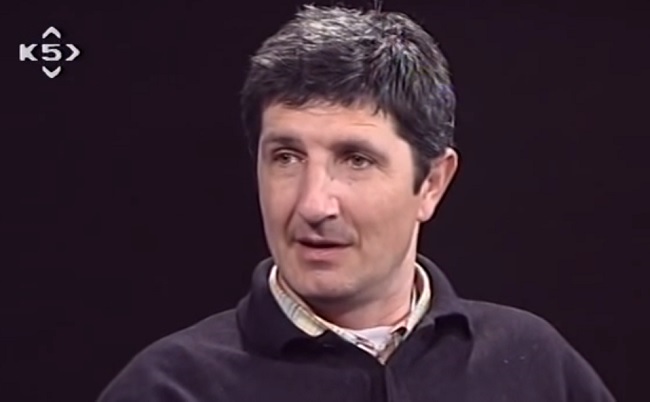
Ante Tomić

Ante Tomić (Split, 1970) is an author, journalist, satirical columnist, blogger and screenwriter. He graduated in Philosophy and Sociology at the Faculty of Philosophy in Zadar. Ante Tomić won several awards for his journalistic and literary work, including the Croatian Journalists’ Association Award "Marija Jurić Zagorka" for the best reportage and the prestigious Kiklop Award for his 2006 short story collection Obedient Citizen (Građanin pokorni).

Several of his titles have been successfully adapted for the big screen and theatre, including his 2000 novel What Is a Man Without a Moustache, his 2003 novel Nothing Should Surprise Us, and The Constitution, co-authored with Rajko Grlić. Ante Tomić also wrote screenplays for the movie Last Will (2001), the TV show New Age (2002), co-authored with Ivica Ivanišević and Renato Baretić, and the erotic melodrama Let This Stay Between Us. He works as a professional journalist for the newspaper Jutarnji list.

Foto: YouTube (Kanal 5 TV)


Jagna Pogačnik, Jutarnji list on Unterstadt

A complex and carefully narrated novel of the author's story of four generations of women of a family of German extraction in Osijek. On the background of the 20th century history and its tragedy is unwound story about identity and family secrets, fate and trauma, enriched with a sense of detail and atmosphere, refined sentences and large theme reduced to an intimate story of individuals.


Ante Tomić-works/transl

MAIN WORKS

I Forgot Where I Parked (Zaboravio sam gdje sam parkirao, Književni krug, 1997; Hena com, 2001), stories
What Is a Man Without a Moustache (Što je muškarac bez brkova, Hena com, 2000), novel
The Folklore Festival (Smotra folklora, Hena com, 2001), feuilletons
Nothing Should Surprise Us (Ništa nas ne smije iznenaditi, Fraktura, 2003), novel
Big Shopping (Veliki šoping, V. B. Z., 2004), stories
Class Optimist (Klasa optimist, Hena com, 2004), columns
Love, Electricity, Water & Telephone (Ljubav, struja, voda, telefon, Jutarnji list, 2005), novel
Umbrella Organization and the Other Play (Angels of Hell) (Krovna udruga i druae drama (Anđeli pakla), drame; s Ivicom Ivaniševićem, Fraktura 2005.
Obedient Citizen (Građanin pokorni, VBZ, 2006), short prose
A Promising Boy (Dečko koji obećava, Europapress holding, 2009), columns
The Miracle in Viper’s Glen (Čudo u Poskokovoj Dragi, Naklada Ljevak, 2009), novel
I Don’t Know (Nisam pametan, Naklada Ljevak, 2010), columns
Tadpoles (Punoglavci, Naklada Ljevak, 2011), novel
The Magnificent Vipers (Veličanstveni Poskokovi, Hena com, 2015), novel
The Constitution (Ustav Republike Hrvatske, Hena com, 2016), novel, co-authored with Rajko Grlić
Look What the Cat Dragged In (Pogledaj što je mačka donijela, Hena com, 2017), short stories
Đuro, The Walker (Đuro Hodalica, Hena com, 2020), picture book
The Hope (Nada, Hena com, 2024), novel


TRANSLATIONS

What Is a Man Without a Moustache: Czech Republic (Kniha Zlin), Slovenia (V. B. Z.)
Nothing Should Surprise Us: Slovenia (V. B. Z.)
Big Shopping: Slovenia (V. B. Z.)


Monika Herceg on Contagious Zone

Contagious Zone, written in two voices during the first lockdown and the Zagreb earthquake, is one of the significant artistic documents of the time that has befallen us. This manuscript by Andrijana Kos Lajtman and Damir Radić  is of exceptional strength, but also of undiluted language which dissolves the worries, the fears, our everyday life – all of which is now increasingly in focus. The dual voice itself… seems to be the ideal way to establish a dialogue, an attempt to articulate a world that suddenly stopped with us trapped in it, but through two voices who are now searching for their unique language, a way to deal with what is beyond them.


Teofil Pančić, Jutarnji list on The Miracle in Viper’s Glen

With this novel, Tomić did something very important: by portraying one undoubtedly oppressive and narrow-minded world, whose codes, rites and beliefs have not changed much since the times when Napoleon’s soldiers raided Dalmatia, the writer has masterfully created his characters - but not in order to prove he is „better“ than them; on the contrary, he has done it to show that we all share the same passions and that everything else is nothing but excessive pride! – and apparently lightly, as if sitting in a café, woven a story which is more „contemporary“ than many pompous, urban tales.


Tanja Tolić, Najbolje knjige

Ivica Prtenjača is first and foremost a poet – his expression, even in prose, has no redundancy, it is poetic, perfectly precise, and rich... In some other countries, Prtenjača would also write short books, but he would be a star – one of those authors whose books are eagerly awaited and read early in the morning, late at night, on the train, bus, or subway... Books that transform readers from savages during work hours to human beings thirsty for beauty.


Main works/Translations
Sample translation
Links
Contacts