The Tportal Award for Best Novel panel

This immensely playful and only seemingly messy, but in fact carefully thought-out and ambitious novel with a polished sentence, which required extensive research work, both in facts and in the speeches of various areas where Gila travels, we consider to be a unique literary work full of humor and irony; past comes to life to speak to us about our present time, especially about the women’s traumatic experiences, contributing to the empowerment of women through their own textual negotiating practices and gestures of resistance.


Goran Ferčec-linkovi

http://www.fraktura.hr/autori/goran-fercec/
http://www.jutarnji.hr/goran-fercec--rad-u-kazalistu-uvijek-je-borba-s-konvencijom/978689/
http://cekape.com/goran-fercec/


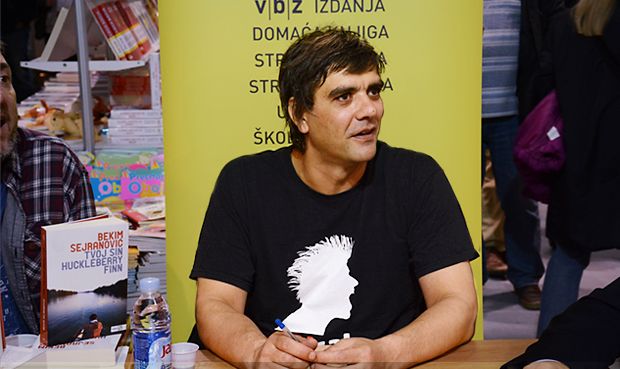
Bekim Sejranović

Bekim Sejranović (Brčko, Bosnia and Herzegovina, 1972 – Banja Luka, Bosnia and Herzegovina, 2020) has lived in Rijeka since 1985 and studied Croatian Language and Literature there after finishing secondary school. Since 1993 he has been living in Norway, where he gained a Master’s degree in Southern Slavic Literature and worked as a university lecturer. Bekim Sejranović translated several works from Norwegian into Croatian, including books by Frode Grytten, Ingvar Ambjørnsen and Jostein Gaarder.

In 2002 he published the collection of short stories, Fasung. This was followed by the novels Nigdje, niotkuda (2008), for which he was awarded the renowned regional Meša Selimović Literary Prize, and Ljepši kraj (2010). His works have been translated into Norwegian, Slovenian and Macedonian. Bekim Sejranović lives and works between Oslo, Brčko, Sarajevo, Ljubljana, Rijeka and Stari Grad.

His novels and short stories have been translated into Norwegian, English, Slovenian, Macedonian, Czech, Italian and Polish.


Goran Ferčec-sample translation

Goran Ferčec: There Will Be No Miracles Here, Fraktura, Zagreb, 2011

Excerpt from Chapter 20

There should be rest on the seventh day. Father has kept going all day. He has been carrying things out from the shed and piling them up on the lawn by the house. It is impossible to figure out the logic he uses to divide them. Bender is keeping up with father’s pace, helping him to transport pieces that are too large for one person. Things piled up on the lawn resemble debris from some accident no one remembers anymore. Except father. Father is the only remaining witness and knows where each item goes, although things have lost shape, purpose and meaning. Exposed to the Sun, they give off an intolerable smell of dampness and staleness. Father decides which thing belongs to which heap. Father is saying, this goes here, that goes there. The determination of the gesture makes his decisions convincing. Bender is certain father does not know what he is doing. Father’s body is sweaty, threatening to stop at any moment. The doors and windows of the house are open, but that does not make it any easier to be outside. Father enters the shed. Father speaks out from the shed: I’ll do what I have to. I’ll return the things to the houses they had been taken from. I know what belongs where. Bender asks father in the shed: How do you know what belongs to whom? Father does not answer. The things have short shadows. It seems as though they are trying to crawl under the things themselves. Without shadows the things are unrecognizable. There are no longer any things in the shed. Bender does not understand what father is doing in a shed where there are no longer any things. In the place where the things were only traces have remained. Through the shed’s door Bender can see father pacing from one corner to the other, checking the emptiness that has emerged in the place where there was none up until a minute ago. Father walks out of the shed. Wooden beams are piled up against the exterior wall of the shed. Six-meter beams are the biggest thing that must be returned. They are so long that they cannot bear their own weight, which has caused their ends to curve up and start rotting. Father approaches the beams. Measures their length with his steps. Then does the same in the opposite direction. Father says: The beams are six meters long. They could be used as rafters or joists, if someone was to build something. Bender is standing in the shadow that the house wall is casting onto the lawn. The shadow with its clean-cut edges is shifting as fast as the Sun is moving. Father gets into the shadow and walks back out of it without paying any attention to its edges. Bender is following father’s movements and his voice. Father clasps one end of the beam with both hands and tries to move it, but manages only to turn it around its axis. The beam starts slipping across other beams and stops only after it touches the ground. Father gives it a kick. Bender crosses over, picks up the beam at the other and pulls it up. Father bends down and does the same on his end. While they are standing with the beam in their hands, father says: We are lucky because the beams are dry, which makes it easier. Bender looks around, searching for a spot where he could drop the beam. Father notices Bender’s wish to move, get the job done, see the task through. Father tries to justify the pointlessness of the situation and says: It’s best to leave the beams where they are or saw them up into smaller pieces. Bender feels the pain radiating form his shoulder blades into both arms. The distance between father and son will remain the same, regardless of where they move to, as long as they keep holding the beam in between. They are going round in circles. Father says: This could be perfectly useful lumber for someone who chooses to build. There’s enough for an entire roof frame. On a house with one or two floors. There would even be some left. Bender shifts the beam into his right hand and brings the fingers on the left one up to his nose. Resin, says Bender. Father is looking at him, tilting his head right. A fir beam, says Bender. A fir beam, father repeats. Fir, says Bender. Impossible, says father, that must be chestnut. Bender lowers his end to the ground. Father remains standing, holding the beam. Bender moves over to father and sticks his fingers under his nose. Father takes a whiff. Fir, says father. Bender goes back and picks up his end. For a few moments father is silent and then he says: Fir is too heavy for roofing. That requires a lighter wood. What kind of lighter wood? asks Bender. Chestnutbeechoak, says father. What’s going to happen with these then? asks Bender. Father does not answer. Bender gets the impression that they are at the beginning of a big renovation. They must decide where to start from. Father knows what he is doing, but the world has shrunk, leaving just enough space for one minor dilemma. Father’s head is turning left-right-up-down. Right-left-up-down. Each point of view is too short for a six-meter beam. Father puts his body weight into the beam and gives Bender a push. Bender is caught off balance and takes several steps back. Father nods in his direction to let him know that he has decided. We are going to pile the beams around the things they’ve taken out on the lawn, says father. Bender fails to realize whom father is talking about. Bender asks father: Who has taken the things out on the lawn? Father answers: We have taken the things out on the lawn. It sounded like you’ve said they, says Bender. Who’s they? asks father. I don’t know, you’ve said they, Bender answers. Father pushes Bender off to the edge of the yard and nods over to signal that this is the spot where they will lower the beam. Both drop their end at the same time. The beam falls and thumps onto the ground. Father eyes the beam and lines it up with his foot. They go back for a new beam. Father in the front, Bender behind him. As they keep moving beams one by one, each new beam seems lighter to Bender. As if the final decision on its purpose has reduced the weight that had been piled on by years of storage. The last beam is as light as a match, making the two of them as strong as ants. While they are carrying it over to the only free spot that will mark the end of the afternoon game, father is laughing. It has been a long time since he did so much for himself and the community. You cannot make everything out of nothing, but you can make a little something. Where there’s nothing, even a little goes a long way, says father. The only unfortunate thing is that where there is nothing, there are also no witnesses who would corroborate that a little can be a lot. They put down the beam, and on the lawn in front of the house there is now another house. Framed by beams, the things are lying as if they were in small rooms. Two diagonally placed beams at the bottom create a roof. The house is hanging upside down. The rendering is neither authentic nor logical. Father is confusing top view and front view, up and down. This does not diminish the logic. To someone watching from the air, this is a clear top view of a house with four identical rooms and a double-pitched roof, upside down. Each room is full of things no one needs.


Bekim Sejranović-works/transl

MAIN WORKS

Fasung (Fasung, Naklada MD, 2002), short stories
From Nowhere to Nowhere (Nigdje, niotkuda, Profil, 2008), novel
The Better End (Ljepši kraj, Profil, 2010), novel
Sandals (Sandale, V. B. Z., 2013), novel
Your Son, Huckleberry Finn (Tvoj sin Huckleberry Finn, V. B. Z., 2015), novel
A Nomad’s Diary (Dnevnik jednog nomada, 2017), travel/diary prose


TRANSLATIONS

The Better End: Czech Republic (Dybbuk), Macedonia (Blesok), Norway (Bokvennen Forlag), Slovenia (Arsem)
Your Son, Huckleberry Finn: Italy, Slovenia (Primus)
From Nowhere to Nowhere: Macedonia (Makedonska reč), USA (Sandorf Passage)


Damir Radić

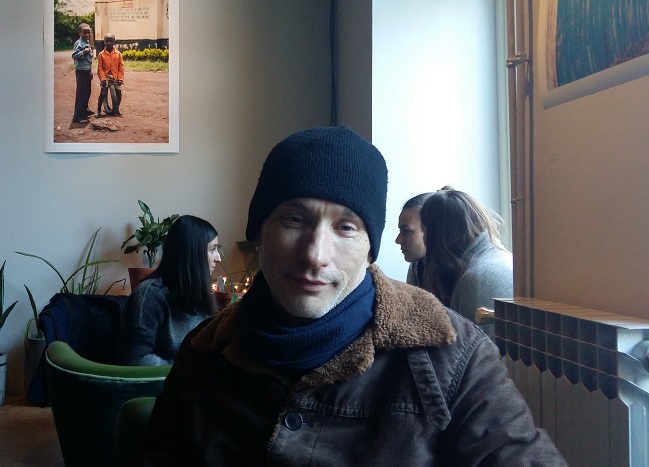
Damir Radić (Zagreb, 1966) is a poet, filmmaker, film and literary critic. He graduated in History and Comparative Literature from the Faculty of Humanities and Social Sciences in Zagreb. Many of his poems have been included in numerous anthologies and translated into Hungarian, Polish and Slovene.

Radić is also the author or co-author of more than forty films which include both short (documentary, experimental and hybrid films) and feature films like Last Days of Summer (2018). He received many awards for his works (both literary and film), including the Kvirin Award for poetry, Vladimir Vuković Award for Film Critics and the Veliki Brcko Award of the Pssst! International Silent Film Festival.

With fellow poet Andrijana Kos Lajtman, he published a conceptual poetry collection Contagious Zone which was shortlisted for Tin Ujević Award, considered one of the most prestigious awards in Croatia. 


NRK Norway on The Better End

This is not a book about the Balkans or about coming to Norway as a refugee, it is not a book about war, trauma and refugee reception and whether it is difficult to understand the new country and its language. Part of this may be a backdrop, but the novel is a story about an individual who crumbles down history in a scrapbook and who hardly has any ambition to represent refugees from the Balkans or anything other than himself. He looks more like […] Anne Oterholm or Trude Marstein, characters who draw another line in time, showing us what we are on the brink of. The Better End is simply-put a noteworthy contemporary European novel.


Damir Radić-works/transl

MAIN WORKS


Lynx Hunting (Lov na risove, Meandar, 1999), poetry collection
Strawberries and Chocolate (Jagode i čokolada, Vuković & Runjić, 2002), poetry collection
Soft as snow and warm inside: the most beautiful hits and rarities (Meko kao snijeg i toplo iznutra: najljepši hitovi i rariteti, DPKM, 2006), poetry collection
The Beautiful and Damned (Lijepi i prokleti, NCL, 2007), novel
Buried Secret (Pokopana tajna, Vuković & Runjić, 2010), poetry collection
Earlier (Ranije, Vuković & Runjić, 2019), poetry collection
The Infectious Zone (Zarazna zona, Fraktura, 2021), poetry collection cowritten with Andrijana Kos Lajtman
Like the Life Itself (Kao život sam, V.B.Z., 2021), poetry collection


TRANSLATIONS*

*none so far


Main works/Translations
Sample translation
Links
Contacts